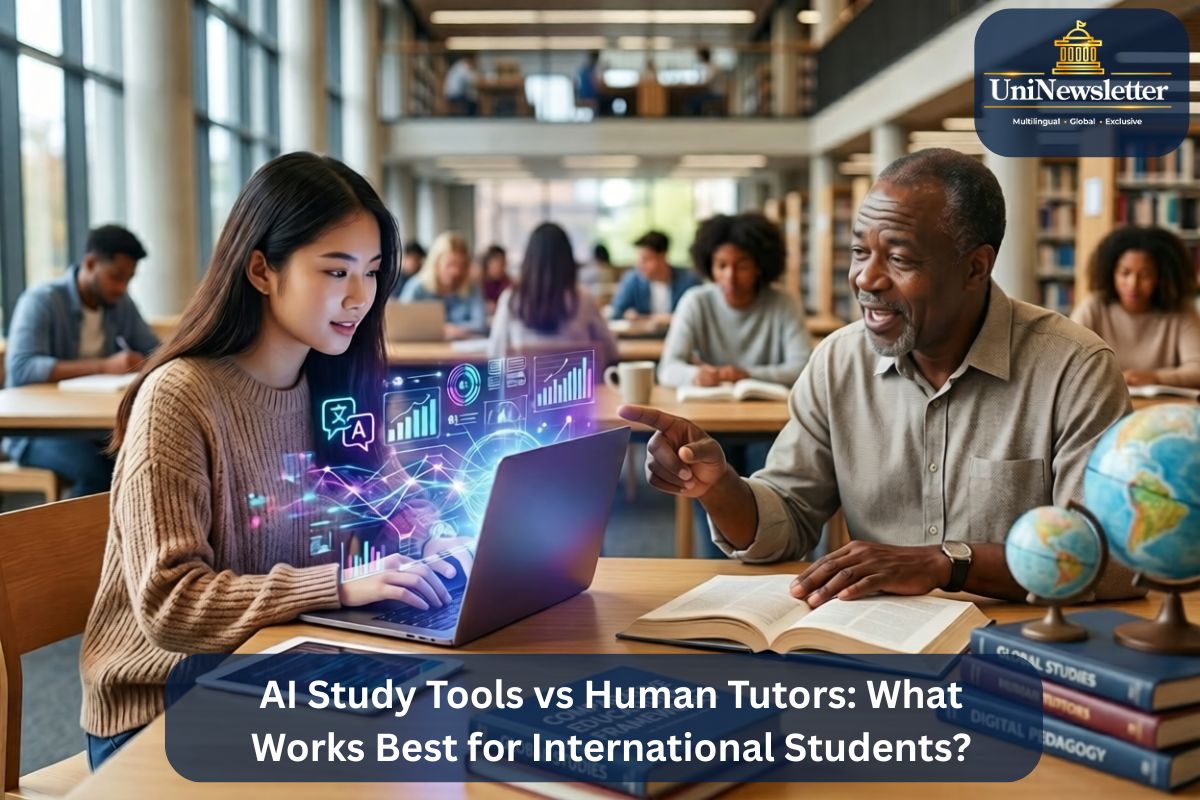
AI Study Tools vs Human Tutors: What Works Best for International Students?
Picture this:
This is the reality for millions of
international students in higher education right now. And it's why the AI study tools vs human tutors debate
isn't just an academic one, it has real, practical consequences for how international students learn, cope, and
ultimately perform.
Why International Students Need Additional
Learning Support
Going abroad for studies can be really
tough in ways local students can hardly imagine. Firstly, there is the language barrier, even those students who
speak English very well may find writing academically, understanding lectures and participating in seminars very
challenging. Secondly, there is a cultural difference in education methods: while some educational systems
emphasise learning by heart and exams, others reward critical thinking and personal research. Thirdly, there is
the loneliness of being away from family, finding your way in a new city plus in most cases, balancing work and
studies.
In a research release published at the
Frontiers in Psychiatry in 2025 the authors found that economic difficulties and heavy schooling demands are the
two main causes that international students suffer mental health problems and also students having difficulties
academically usually have less access to learning support.
International student's choices have
improved much by 2026 and are even better than three years ago. AI-based learning tools for students have become
quite advanced. Besides, the possibility of online tutoring of high quality and at reasonable prices has
increased globally.
What Are AI Study Tools?
Student AI study tools include
broad-purpose assistants like ChatGPT and Microsoft Copilot, as well as specialized academic platforms like Khan
Academy's Khanmigo Grammarly Quizlet AI, Otter. ai for lecture recording, and even research tools like Consensus
or Elicit.
The common thread amongst them: they are
accessible 24/7, budget-friendly or even free, and can switch to whatever a student needs at that particular
moment, such as outlining a difficult research article, creating practice tests, breaking down a concept in
simpler terms, or proofreading academic paper for better clarity.
In early 2026, AI devices' usage had reached around 92% of students worldwide, while in 2024 it was only 66%. About 80% of students say AI has helped
raise their academic results level while according to Coursera's February 2026 survey only four countries were
surveyed by 4,200 people. Khan Academy's Khanmigo AI tutor's users increased from 68,000 in 202324 to over 1.4
million by the middle of 2025.
These figures indicate a real change in
student learning methods, besides mere trials.
What Are the Benefits of AI Study Tools
for Students?
For international students specifically,
AI study tools address several real pain points:
Availability without scheduling. A student
in Melbourne studying at midnight doesn't need to wait for a tutor in London to wake up. AI tools respond
immediately, any time.
Language support. Grammarly and ChatGPT
are examples of tools that can assist international students to fix academic writing, to check grammar, and to
write sentence from scratch or to rephrase sentence without they figuring out that their sentences have a
problem, this way they would not put themselves in an embarrassing situation by asking a friend to proofread
their essay.
Personalised practice. AI platforms
generate practice questions based on a student's weak areas, adjusting difficulty as performance improves. A peer-reviewed randomised controlled trial published in Scientific Reports in June 2025 found that an AI tutor
produced learning gains between 0.73 and 1.3 standard deviations better than traditional in-class learning, and
students achieved these results in less time.
Affordability. Human tutors typically cost
between £30 and £80 an hour in the UK, more in North America and Australia. Most AI study tools are free or cost
a few dollars a month.
Where Human Tutors Still Have the
Advantage
None of that means human tutors are
redundant. Far from it.
Human tutors can interpret emotional
states with 92% accuracy, compared to 68% for even the most advanced AI tutoring systems, according to 2026 data from DemandSage . When an international student is struggling not just with calculus but with the confidence to
ask questions in tutorials, a human tutor notices and responds to that in ways an AI cannot.
In addition to being able to provide
correct answers, human tutors also have a great depth of subject knowledge. Besides just giving answers, a great
tutor also clarifies the reasons behind things, critically evaluates weak arguments and changes the teaching
approach based on the insightful understanding of how a particular student thinks. Besides accountability of
being paid and having someone waiting for you, a tutor session also encourages you to prepare.
To name a few situations where human
tutoring wins a big time over AI: learning complex theory, preparing for oral exams or developing academic
writing skills in a second language. The human aspect of tutoring still results in outcomes that AI has not been
able to replicate so far.
Online Tutoring vs AI Study Tools: A
Side-by-Side Comparison
Basis
AI
Study Tools
Human
Tutors (Online)
Availability
24/7,
instant
Scheduled
sessions
Cost
Free
to low-cost
£30–£80+
per hour
Language
support
Strong,
grammar and writing assistance
Varies
by tutor
Emotional
support
Limited
High
Accountability
Low
High
Depth
of explanation
Good
for concepts, weaker for nuance
Stronger
for complex reasoning
Personalisation
Based
on performance patterns
Based
on real understanding
Best
for
Based
on performance patterns
Concept
mastery, confidence, writing
Which Option Works Best for Different Student Needs?
There is no single correct answer as to what to do in school; it is entirely dependent on the students'
struggles and their needs.
If the challenge is practice and revision, AI tools win. They're faster, available whenever needed, and
generate unlimited practice material.
Though, if the problem is grasping a new concept for the very first time, human tutors can bring about
better results, In particular when it comes to concepts needing explanations and exchanges.
The academic writing challenge in a second language calls for a combo of both performing best: AI for
grammar and structure checking whereas human tutor for developing argument and voice.
And if the problem is lack of motivation as well as non-compliance, then human tutors are unquestionably
superior because no AI tool will be aware of whether you have been procrastinating your thesis for three
weeks or not.
The Rise of Personalised Learning with AI Tools
What's changed most significantly is how much AI tools have moved beyond generic responses toward genuinely
adaptive learning. Besides students individually, artificial intelligence is also making a difference in the way higher education operates at the institutional level as well.
Platforms now track what a student gets wrong, how long they spend on each question, and which topics
consistently cause errors, then adjust what they teach next accordingly. This kind of personalized learning
with AI tools was expensive and rare five years ago. In 2026, it's available free or at low cost to any
student with a smartphone.
Research conducted in the Middle East highlights the magnitude of this change as students in the region not only expect and want AI assistance but also associate AI in a positive way with their academic futures.
Why a Hybrid Approach Is Probably the Right Answer
The concept of "AI vs human tutors" is a rather misleading one as it suggests a rivalry which is not really
the way effective learning mostly takes place.
Students familiar with two learning modes, i. e. using interactive modes and the traditional modes, are
capable of turning to AI tools for their language practice, revision, and support. At the same time, they
make use of human tutors to help them with developing a deep academic understanding in essay-writing and
acquiring profound knowledge that results in expertise rather than familiarity only.
Think of it this way: AI tools keep your learning engine running between sessions. Human tutors help you go
places the engine alone can't reach.
The Future of AI and Human Tutoring in Higher Education
The direction is clear. AI tutoring is going to become more capable, more personalised, and more embedded
in how universities deliver education. UNESCO's September 2025 survey across 90 countries found that
two-thirds of higher education institutions have or are developing guidance on AI use, a sign that
institutions are taking AI's role in learning seriously rather than treating it as a passing concern.
But the data is equally clear that human connection in learning doesn't disappear. That 92% emotional
accuracy edge in human tutors over AI systems points to a really deep element of human interaction -
empathizing, understanding the real emotion behind the confusion and frustration a person's specific need.
It's not something that can be engineered away very quickly.
Going to college being an international student in a new country, probably the smartest way is to blend
both: AI for helping you on the spot, and human tutors when you want to understand and rethink deeply.
Thinking about your options as an international student? UniNewsletter gives you the opportunity to find
universities that make student success a priority, from AI-enhanced learning environments to dedicated
international student support.

 26-05-2023
American University of Ras Al Khaimah
26-05-2023
American University of Ras Al Khaimah 


 Featured Video