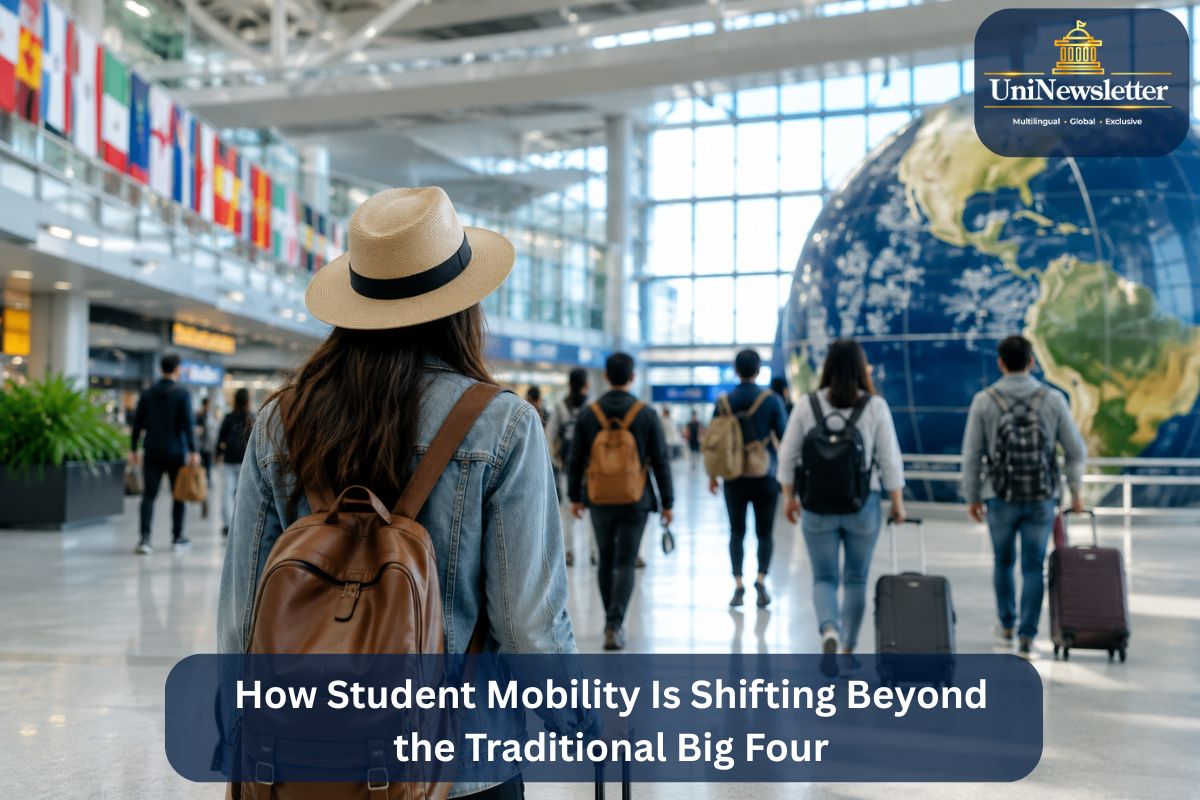
How Student Mobility Is Shifting Beyond the Traditional Big Four
For nearly 20 years, the focus when it came to studying abroad was limited to just four countries: the United States, United Kingdom, Australia, and Canada. These were the options that most families envisioned, the ones appearing on every university fairs' brochures, and the places that seemed to represent the ultimate dream of an international student's future.
But, in 2026 "that map" is going to change.
This transformation is neither a sudden one, nor a small one. Based on BONARD's analysis of global mobility data in December 2025, over the past one to one and a half years, as many as half a million international students have changed their mind for the Big Four countries and have chosen other countries instead. Europe and Asia have taken in most of these redirected students, and the trend is definitely growing.
So what's driving this, and what does it mean for students, universities, and the future of international education?
What Made the Big Four So Dominant in the First Place? Over time, the US, UK , Australia, and Canada have become major global players in education. High-quality universities, instruction in English, visa privileges for graduates seeking work, and excellent immigration systems made them the most appropriate options for those planning to study abroad. These countries were more than mere destinations, they set the very standards.
At their peak, the Big Four collectively hosted the majority of the world's internationally mobile students. The formula worked: invest in a degree in one of these countries, and the return, academic, professional, and personal, seemed reliable.
But the formula has started to look a lot more complicated.
Why Students Are Looking Elsewhere Now Three things are pushing students toward alternative study abroad destinations simultaneously, and together, they're changing the market faster than most institutions expected.
Policy instability. Canada introduced hard caps on international student intake in 2024. The number of study permits granted dropped to 262 100 which is almost 48% less than the 2023 level and approximately 100,000 less than the government's target. This limit extends to 2026, at 408,000 permits, 16% less than the 2024 target. In the United States, the ambiguity around visa processing and immigration policy seems to have had a deterring effect, based on IIE data there was a 17% decrease in overall international commencements for 2025/26. Australia and the UK also see their own intake decreases, with the UK seeing its first drop in foreign enrolments in a decade in 2023/24, down by 7%.
Rising costs. Program fees in the leading four cities have risen steadily, and the scarcity of housing has made living costs in cities such as London, Toronto, and Sydney quite challenging on a student budget. Parents are raising more tough questions about the value for money.
Widening options. Several other countries have been upscaling their tertiary education programmes in English, at prices that are competitive, and with the provision of clear post-study routes. And students are discovering them.
The Destinations That Are Gaining Ground Keystone Education Group 's analysis results of student search and enrolment for 2025 are quite a revelation. International student search interest has been strengthening in countries like Spain Italy Germany, France Malaysia Singapore, Thailand, and South Korea. Germany's foreign enrolments kept on increasing even in the 2025/26 academic year. Japan achieved the foreign enrollment of 400,000 which was the target surpassing the same in 2025.
A few destinations worth watching more closely:
Germany: The extremely low or even zero tuition fees at public universities, a well-organized immigration route for skilled workers under the recently updated residence permit system, and robust industry-integrated curricula have made Germany a top choice among the most consistently attractive international destination options. Engineering, business, and sustainability programmes in particular are generating high levels of interest.Japan: Besides robotics design engineering, and technology courses, Japan also benefits from the government's initiative to increase the number of international students to compensate for its declining population, This way making the country an enhancing source of attraction In particular for learners from South and Southeast Asia.Ireland and the Netherlands: Due to mainly English language and with respective strengthening post-study work options, these countries have become 'new' preferred creative destinations amongst students from markets like India and Nigeria as interest towards the Big Four cools down. Malaysia and Singapore: Students from South and Southeast Asia wanting internationally connected, quality education at an affordable cost will find these countries ticking many boxes. Singapore's finance and tech ecosystem appeal to postgraduates while medical and business programmes in Malaysia attract undergraduates.Spain and Italy: The European lifestyle, lower living costs compared to the UK, and an increasing number of English-taught programmes are factors at the top of the list for students who were previously just considering the idea but are now seriously applying.In line with the documentation from IC3 Movement's global network of counselors and universities, the discussion around education abroad has progressed from "which of the Big Four? " to "which country's offerings align with my needs?"
What's Making These Destinations Attractive Beyond Cost Price remains the greatest factor for diversification Yet it is not the only one. To make a decision, students and families are considering several things at the same time:
Policy transparency: Countries with clear visa processing, post-study work rights, and immigration setups that students from markets get attracted to are those that are tired of uncertainty. The regulated residence permit process of Germany and Ireland's enhanced graduate pathways are the two instances that often come up in counselling.Industry alignment: Nowadays, students decide on a study location not only based on the university rankings but also to the leading industry in the region. For example, South Korea is well-known for creative technology, Finland for sustainable development, and Singapore for finance and cybersecurity. Such connections are gaining the same level of influence as the reputations of the institutions themselves.Mental health and quality of life: This is a newer factor but has really started to influence people's choices. The Nordic countries always come top in the rankings for student mental health and overall living conditions. Those students who are looking at different options are taking this into account.Cultural belonging: Larger international student communities in emerging destinations have reduced the sense of isolation that once made alternative destinations feel riskier.Understanding how geopolitics is influencing study abroad destinations is essential here, policy environments aren't just bureaucratic details, they're shaping student decisions in real time.
How Universities Are Responding The fastest movers among the institutions are those located in the emerging destination that have recognised the opening of the window and acted swiftly.
82% of Asian universities reported more new undergraduate international students in Q1 2026 than in Q1 2025. In Europe, nearly half (47%) of responding institutions reported year-on-year increases, almost double the proportion reporting declines, according to the Studyportals 2026 Global Enrolment Benchmark Survey.
Lots of these universities have launched more English-taught programmes, made funding arrangements for international student supports, and clarified communication around visa and post-study options which are three of the main concerns of students in transition.
Conversely, 80% of Big Four institutions cited that their international undergraduate student numbers decreased in the first quarter of 2026, which is higher than the 71% reporting a fall in the first quarter of 2025. AACSB's 2025 State of Business Education Report highlights the increasing apprehensions over "demographic changes, political developments, and evolving student patterns" changing international enrollment. The institutions that are faring best in those markets are the ones that diversified their source markets early and established solid recruitment systems in regions like Africa, Latin America, and Southeast Asia.
To get a more detailed understanding of where students are currently targeting, the top countries that international students are considering in 2026 gives a very accurate depiction of the present scenario.
Challenges Emerging Destinations Still Face The opportunity is real, but so are the obstacles.
Brand recognition takes time. A university in Tampere or Krakow or Kuala Lumpur may be excellent, but it doesn't carry the same name recognition with families in Lagos or Mumbai that Oxford or Toronto does. Building that trust requires sustained presence in source markets over years, not months.
Infrastructure gaps. Some emerging destinations haven't scaled up their international student support, housing, mental health services, language support, as quickly as their enrolment ambitions. That gap shows in student satisfaction data and word-of-mouth, which travels fast.
Visa processing backlogs. Even in destinations with good policies on paper, application delays and inconsistent processing can dent confidence at the point of decision.
Language and integration. For students choosing non-English-speaking destinations specifically for the cultural experience, the jump is significant. Universities that invest in structured cultural and language integration programmes fare better on retention.
The Future of International Student Mobility BONARD's analysis projects Asia growing at 10–15% annually, driven by regional mobility, improving quality of higher education, and rising domestic economies. Europe is expected to continue its steady gains. The Big Four are not collapsing, but any "rebound" will be slow and uneven, with the US and Australia likely to decline further in 2026 before stabilising.
The phrase that's gaining traction in global education circles is the shift from "Big Four" to "Big Fourteen", a more distributed global map where ten or more additional destinations play a meaningful and growing role. That framing is starting to feel accurate.
One region worth watching closely is Latin America, where several universities are making genuine strides in international profile and English-taught programme development. The rising role of Latin America in global university recruitment is an area many recruitment strategists are only beginning to factor in.
Conclusion The worldwide student mobility map in 2026 is quite a bit different from that of five years ago, and the rate of change is quickening instead of slowing down.
Such the choice for students is more real than ever before; after all, the question is not just "am I eligible?" but "which country, which educational system, and which industrial environment really corresponds to what I want to create?"
For universities, it means the competition for international students is no longer just between institutions. It's between entire countries and regions, and the institutions that understand that are the ones building sustainable international pipelines.
If you're navigating these decisions, as a student, a counsellor, or an institution, UniNewsletter tracks the trends, the data, and the opportunities shaping global higher education.

 26-05-2023
American University of Ras Al Khaimah
26-05-2023
American University of Ras Al Khaimah 


 Featured Video