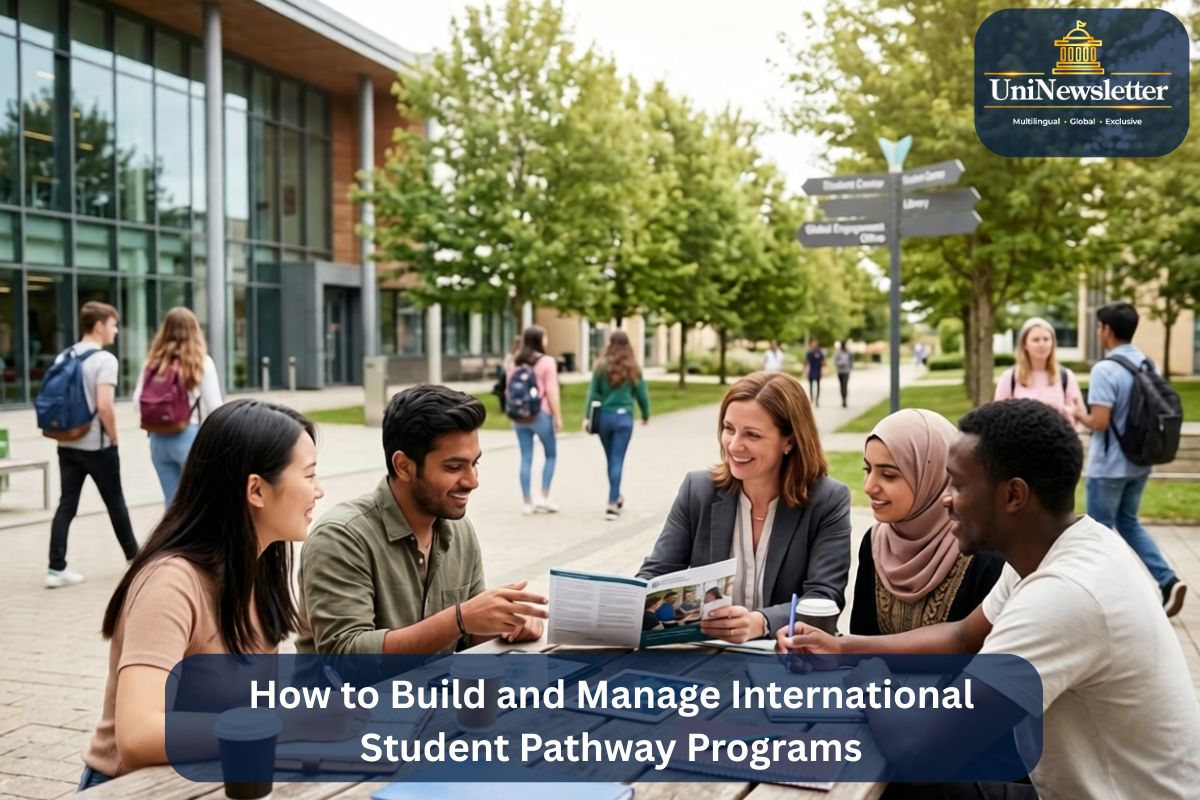
How to Build and Manage International Student Pathway Programs
There’s a quiet, but very real shift happening in global higher education right now.
Institutions that used to attract students worldwide quite easily are now being challenged with tough questions about the students' origins, reasons for the rising attrition rates, and how to position themselves in the global market which has become the most uncertain one in years. New overseas student registration in the US decreased by 17% in fall 2025, marking the first major drop after four years of post-pandemic growth, as per the data of IIE's Open Doors Snapshot. Canada has limited the intake of international students for 2026. The UK recorded its first ten-year decline in the total number of enrolled students in 2023/24.
In this kind of environment, pathway programs have basically slid from “nice to have” to something that genuinely shapes long-term enrollment strategy. When they’re done right, they don’t only usher students in, they attract the right mix and keep them there.
So, what does building and managing a strong international student pathway program actually look like?
What Are International Student Pathway Programs? Essentially, pathway programs are academic bridges with a set structure. They help international students who have some university potential but still don’t quite meet the direct admission requirements, like English language proficiency, academic results, or, preparation in specific subjects, so they can reach the level that’s needed.
The main types universities offer:
Foundation programs - usually one year long, these are aimed at students from secondary education who require both academic and language training before embarking on an undergraduate programUndergraduate pathway programs (International Year One) - they amount to first-year undergraduate study and permit students to transfer into Year 2 of a degree directlyPre-master's programs - one semester or year of training for students wanting to pursue postgraduate studiesEnglish language pathways - intensive English language courses that, upon attaining a particular level, allow students to be exempted from the TOEFL or IELTS requirements at partner universitiesA point that generally escapes notice is that pathway programs are not remedial. They are designed for students who are productive academically but require language skills enhancement, cultural introduction, or subject-specific knowledge to be able to perform at degree level.
Why Pathway Programs Matter More Than Ever Right Now With direct international enrolments under pressure globally, pathway programs give universities a pipeline they can actually manage and predict. Students who enter through structured academic pathways tend to arrive better prepared, and research backs this up.
As a research article published in Educational Research in 2024 , students who were led into higher education through a formal academic preparation program were shown to have more proficient academic literacy capabilities compared to those who made the transition without one.
Northeastern University's Global Pathways program, per Higher Ed Dive , revealed that international pathway students were achieving at a level equal to domestic students, which was a point of satisfaction for both faculty and students.
Universities can also rely on the retention point. Students who come ready will have less chances to face difficulties during their first semester, and will be much more motivated to graduate. Besides, this issue is important for the position in rankings, income, and image simultaneously.
Key Components of a Successful Pathway Program Regardless of creating one from scratch or surfacing an existing one, the pillars below are the ones that make the difference most obviously:
1. Academic preparation aligned to the destination degree A business pathway student should be covering economics and research methods. An engineering pathway student needs mathematics and applied sciences. Generic academic programs don't serve students as well as discipline-linked ones.
2. English language development with clear progression benchmarks Define what "ready" looks like. Universities like those partnered with OHLA Schools use a direct progression model, once students reach Advanced Level 2 (undergraduate) or Elite Level (postgraduate), they transfer without sitting IELTS or TOEFL. Clear benchmarks remove ambiguity for students and staff.
3. Cultural orientation and academic skills Critical thinking, scholarly writing, taking part in seminars, norms for giving credit to sources these tend to be greater obstacles than language only. Making them part of the curriculum in a very explicit way, rather than being a secondary idea, results in a very great step change for first-year student performance.
4. Pastoral and wraparound support International students dealing with a new country, a new system of banks, a new housing market, and a new academic culture at the same time, are really up against a lot. Staff who are more exactly there to help, and who have ideally also had international experience, can much lower the dropout rate.
5. Clear progression agreements with degree programmes Students need certainty. A guaranteed conditional place in a specific degree, subject to pathway completion, is far more compelling than a general promise of university access.
How to Build Pathway Programs for International Students, Step by Step Start with your data. Look at where your international students currently come from, which source markets are growing, and where you're losing applicants at the direct entry stage. Those gaps often point directly to where a pathway program adds value.
Define entry requirements honestly. What does a student actually need to succeed in your degree programs? Work backwards from degree-level performance data, not just traditional admissions criteria.
Choose your delivery model. Universities can run pathway programs in house, either solo, with partners like Kaplan, INTO, Navitas, or Study Group, or in that kind of hybrid setup. Each option comes with its own little trade-offs, like how much control you actually keep, what it costs, and how quickly it can scale. Really, the trick to a strong international student recruitment plan begins by figuring out which pathway model fits your institution’s ability and aims, not just on paper, but in practice.
Integrate the program into your university, not alongside it. Students in pathway programs should have access to libraries, student unions, campus accommodation, and university life from day one. Isolation from the main campus community is one of the most commonly cited reasons pathway students don't progress to degree enrollment.
Build in feedback loops from the start. Regular academic reviews, student surveys, and progression tracking from pathway into degree study give you the data to improve year on year.
Managing University Pathway Programs Effectively Building a program is one challenge. Running it well at scale is another.
Staff development matters. Pathway programme staff really do need training in cross-cultural communication, academic English support, and making sure international student wellbeing is looked after, not just knowing the subject.
Track progression in a sort of obsessive way. The key metric isn’t how many students enrol in the pathway, it’s how many complete it, how many actually transition into degree study, and how those students are doing during their first year. There was an Australian Government study, on International Students Outcomes and Pathways, published in August 2025, it found that tracking post-pathway outcomes was the single most important factor for driving ongoing programme improvement (Jobs and Skills Australia, 2025 ).
Don't neglect the retention piece. Helping students complete their courses is just the first step. Retention strategies for international students that begin during the pathway phase rather than after enrolment, end up giving consistently better and longer term outcomes.
The Role of Pathway Programs in International Student Recruitment Globally, 84% of US colleges say international student recruitment is a priority for 2026–2027, based on AACRAO data, and yet overall international enrolments still run into headwinds. In this kind of environment, institutions that are competing for student demand can treat pathway programs as a real differentiator, not just an optional extra.
Basically, they let you reach a broader, more nuanced pool of students, also from markets where English-medium schooling is less common, or where academic systems can be very different than the destination country. Vietnam, India, Brazil, and Bangladesh are among the top growth markets right now for international recruitment, and pathway programs dramatically expand what you can actually access across all four.
University partnership programs that incorporate pathway provision, whether through in-house programs or specialist providers, consistently outperform those relying solely on direct entry in competitive source markets.
Common Challenges and How to Overcome Them Challenge: Students not progressing from pathway to degree Often a sign that entry requirements were set too low, pastoral support was insufficient, or progression agreements weren't clear enough. Review all three.
Challenge: Pathway students feeling isolated from main campus Integrate deliberately. Shared accommodation, mixed social events, and joint academic sessions with degree students during the pathway phase help significantly.
Challenge: Faculty resistance to pathway entrants Data is your best tool here. Share first-year performance comparisons between pathway entrants and direct entrants. Where programs are well-run, the data tends to be compelling.
Challenge: Managing quality across partner-delivered programs Set clear contractual KPIs for partner providers covering progression rates, student satisfaction, and first-year academic performance. Review them annually.
Measuring Success The metrics worth tracking:
Pathway completion rate Progression rate from pathway to degree enrolment First-year academic performance of pathway entrants vs. direct entrants Retention rate through to graduation Student satisfaction scores at pathway exit Source market diversity of pathway intake ICEF Monitor’s analysis of global enrolment trends going into 2026 did note that institutions diversifying their international pipelines, including through pathway provision, were way better positioned to soak up policy-driven shocks in individual source markets, even when those markets do a bit of the unexpected.
Future Trends to Watch Hybrid and online pathway delivery is growing. With 26% of US institutions already planning to expand online programs as an international enrolment pathway, expect pathway programs to follow suit, with blended models that allow students to begin preparation in-country before arrival.Shorter, more modular pathways are gaining ground. The traditional one-year foundation is increasingly being supplemented by eight and ten-week intensive pathways for students who are closer to direct entry standards.Post-study outcome tracking is becoming a differentiator. Universities that can demonstrate not just pathway completion rates but employment and career outcomes for former pathway students are gaining ground in competitive source markets.Conclusion International student pathway programs are not a workaround for weaker applicants. At their best, they're a deliberate, structured strategy for bringing in students who have the academic capability and motivation to succeed, and giving them the preparation to actually do it.
In 2026, with direct international enrolments under pressure across every major destination country, the universities that invest seriously in pathway program design, delivery, and management are the ones building enrolment pipelines that hold up.
If you're building your international recruitment and engagement strategy, UniNewsletter connects universities with the students and tools to make it work.

 26-05-2023
American University of Ras Al Khaimah
26-05-2023
American University of Ras Al Khaimah 


 Featured Video