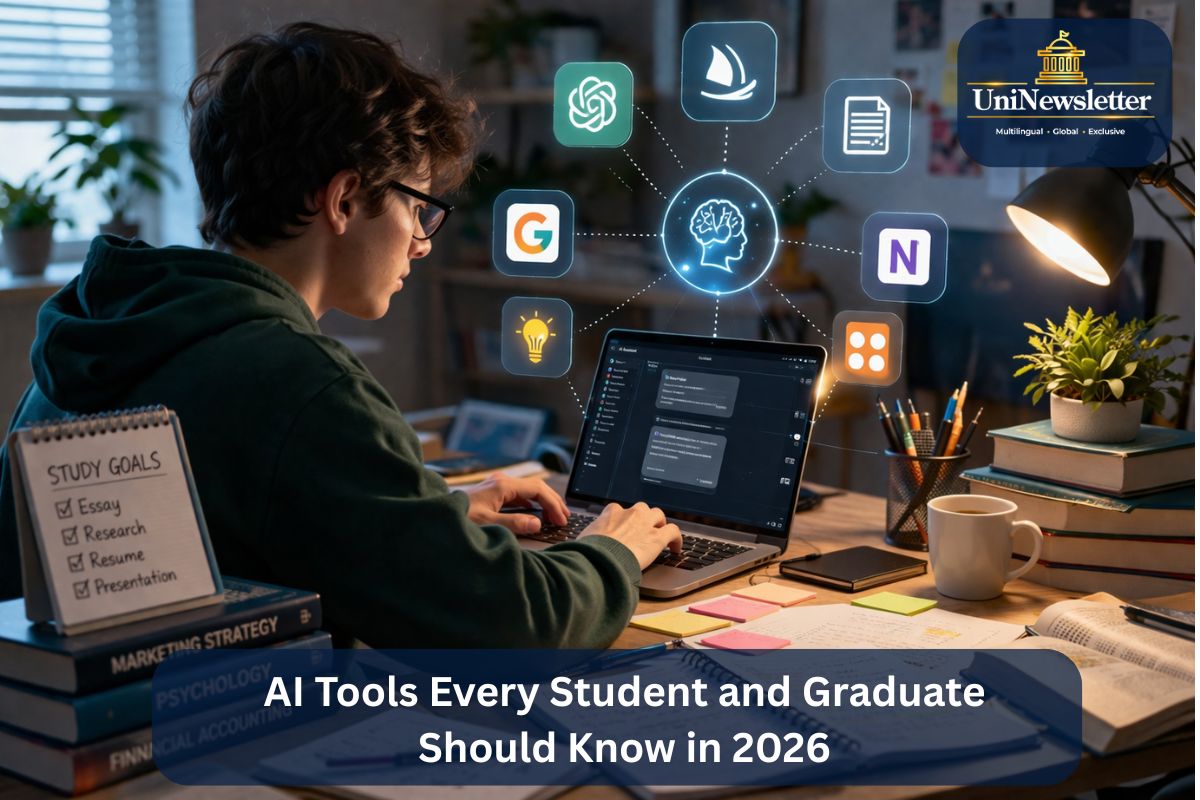
AI Tools Every Student and Graduate Should Know in 2026
Let's be honest, the way students study, research, and prepare for careers has completely changed. And it's not going back.
According to the
Higher Education Policy Institute's 2025 Student Generative AI Survey
, student use of AI jumped from 66% in 2024 to 92% in 2025. That is nearly every student in higher education using AI in some form, whether they admit it or not. Add to that a fresh finding from
NACE's Job Outlook 2026 Spring Update
: more than one-third of entry-level jobs now require AI skills, nearly triple the number from just six months ago.
So the question is no longer should you be using AI tools. It's which ones actually make a difference, and how do you use them well?
At
UniNewsletter
, we track these shifts closely to help students and institutions stay ahead of the curve. The article provides an accurate assessment of 2026 AI tools which offer multiple benefits to students and graduates who need to study for exams and complete dissertation work and prepare for job
interviews.
Why AI Tools Matter More Than Ever for Students
Before we get into the tools, here's something worth sitting with.
The 2025 PwC report discovered that employees possessing advanced AI capabilities receive salaries which exceed their counterparts earning identical salaries but lacking those capabilities by 56%.
McKinsey's most recent workforce research
discovered that job vacancies which needed AI knowledge grew from 1 million in 2023 to approximately 7 million by 2025.
The problem has expanded beyond the technology industry. AI literacy requirements have become essential skills for professionals working in law, marketing, healthcare, finance, education and nearly all other professions. For students and recent graduates, AI proficiency has become an essential
requirement for professional readiness. The
majority of universities in Europe and North America
now develop or implement AI usage guidelines because around 70% of institutions have already reached that point.
The main obstacle that students face involves determining which tools to use and understanding their proper application. Let us provide a detailed explanation. You can also explore how
higher education is responding to generative AI
for more context on where things are heading institutionally.
Writing and Research Tools
Most students begin their academic journey at this point because writing constitutes the largest portion of their educational activities.
The worldwide student population uses
ChatGPT
(OpenAI) as their primary AI tool which approximately 66% of students use for their academic work. The tool provides multiple functions which include helping users to create essay frameworks, transforming difficult ideas into simple terms, enabling users to create draft documents, and
assisting users in developing their thought process during times of mental block. The key is treating it as a thinking partner, not a ghostwriter, use it to sharpen your ideas, not replace them.
Google Gemini
has achieved its full potential during the 2025-26 period because of its enhanced connectivity with both Google Docs and Gmail which enables students to use the tool within their existing Google platform. The tool provides excellent support for creating document summaries while developing
initial research materials.
Grammarly
functions as a dependable academic writing tool which offers more than grammar assessment because it provides tone suggestions and clarity enhancements and identification of excessive use of passive voice. The product holds great importance for international students who need to write
English documents because they face the challenge of using a second language. According to
Zendy's 2025 survey of over 1,500 students and researchers
, 46.3% are already using AI tools specifically for writing and editing, making writing assistance the second most common use of AI in academic work.
Quick tip:
The educational institution requires students to review its AI usage policy before they submit work that contains AI-generated content. Most educational institutions nowadays have quite clear rules about what is allowed and what is not.
Productivity and Note-Taking Tools
Have you ever spent two hours in a lecture and then left with ten pages of disorganized notes which you never used? AI offers a solution to that problem.
Notion AI
serves as an essential productivity solution for students because it enables them to organize all their materials which include notes and to-do lists and project plans and research databases. Its AI assistant can create summaries of your notes and generate study questions from your content
and produce organized study materials without needing to start over.
Otter.ai
transcribes lectures and meetings in real time, then generates summaries you can search by keyword. The system provides actual time-saving benefits to students who need to attend multiple lectures throughout the day and to international students who require recorded session access.
Goblin.tools
serves as an effective yet lesser-known tool that helps students who need assistance with large task breakdowns. The system transforms a general request which says "write my literature review", into specific tasks that users can complete. The solution proves its effectiveness through its
straightforward design.
Design and Presentation Tools
No one wants to sit through a wall-of-text slide presentation. AI has made design genuinely accessible for non-designers.
Canva AI
makes it far easier to create professional-looking presentations, posters, and infographics without any design background. Its Magic Design feature generates layout options from your content automatically, useful for group projects and university presentations on tight deadlines.
Gamma
takes your text or notes and turns them into a formatted slide deck in minutes. It's not built for highly complex presentations, but for quick turnarounds it saves a lot of time.
Coding and Technical Tools
The AI coding tools have become essential for computer science students and professionals who need to handle data.
GitHub
Copilot functions as an AI pair programmer which operates within your code editor to propose code statements and functions while you enter text. The tool reduces time spent on documentation search for CS students who need to learn new programming languages and solve difficult debugging
issues. The student plan is free through the GitHub Student Developer Pack.
The programming community uses
ChatGPT and Claude
to explain code while permitting users to debug software and learn new programming skills. You can find solutions faster by explaining your problem in simple terms to others than by searching through documentation.
Career Preparation Tools
This is the area where AI tools are most underused by students, and where the return is arguably the highest.
LinkedIn's AI
features help with profile writing, job application drafts, and identifying skill gaps based on job descriptions. Given that AI skills are now showing up in a third of all entry-level job postings, building a profile that demonstrates AI fluency is worth the effort.
ChatGPT
for interview prep is something more graduates should be doing. Ask it to run mock interviews based on a specific job description, generate likely questions for your target role, or give feedback on your answers. It's available at 2am the night before an interview when there's no one else to
practice with.
Rezi and Kickresume
use AI to tailor your CV and cover letter to specific job postings, helping you match the language that applicant tracking systems look for. According to research from Thesify's 2025 student AI survey analysis, students who actively build AI skills into both their academic work and career
preparation enter the job market in a noticeably stronger position.
Free vs Paid - What's Actually Worth It?
The majority of essential resources for your initial setup are available at no cost. The free version of ChatGPT together with Canva's free plan and Notion's personal plan and Otter.ai's basic version provides value to users at no cost. Grammarly's free version covers the most common writing
issues.
The most appropriate time to purchase premium services occurs when you begin writing your dissertation work. The student plan for GitHub Copilot provides free access to the tool for users who write code every day. During peak usage times, ChatGPT Plus enables users to use advanced models,
which provide better performance than standard models.
You should begin your tool selection process by testing free tools until you discover which aspect of your work takes the most time. You should only spend money on solutions that effectively address your specific problem.
Using AI Ethically in Education
This part matters, so it's worth being direct about it.
The 2025 HEPI survey found that 53% of students worry about being accused of cheating when using AI, and that concern is valid. The answer to the problem requires organizations to implement AI technology according to their established rules as a method for open and honest usage.
Most universities now distinguish between using AI to support your thinking which they consider acceptable and using AI to replace your thinking which they define as unacceptable. The program functions as a tool which assists you in brainstorming while you develop your ideas and extract
content and build your writing skills instead of using it to create your ultimate output.
The
World Economic Forum projects
that 39% of today's core workplace skills will become outdated or transformed by 2030. Employers will continue to seek candidates who possess critical thinking skills and problem-solving abilities and creativity which belong to that list. Your learning process can benefit from AI support
although AI will not let you develop those particular abilities.
International students who want to understand AI policies at different universities must learn about
AI translation tool usage and regulation at universities
that require students to study in languages other than their native tongue.
The Bottom Line
AI tools are not a shortcut to academic success. But used well, they are a real productivity multiplier for writing quality, research depth, study efficiency, and career readiness.
Students and graduates who achieve maximum benefits from their studies treat AI as a tool which they control instead of using it to complete their work. Start with one or two tools that solve your biggest time problems. Learn them properly. Then build from there.
The current
higher education system and technological advancements
progress rapidly through time. Students who actively participate in this process will achieve better results.

 26-05-2023
American University of Ras Al Khaimah
26-05-2023
American University of Ras Al Khaimah 


 Featured Video