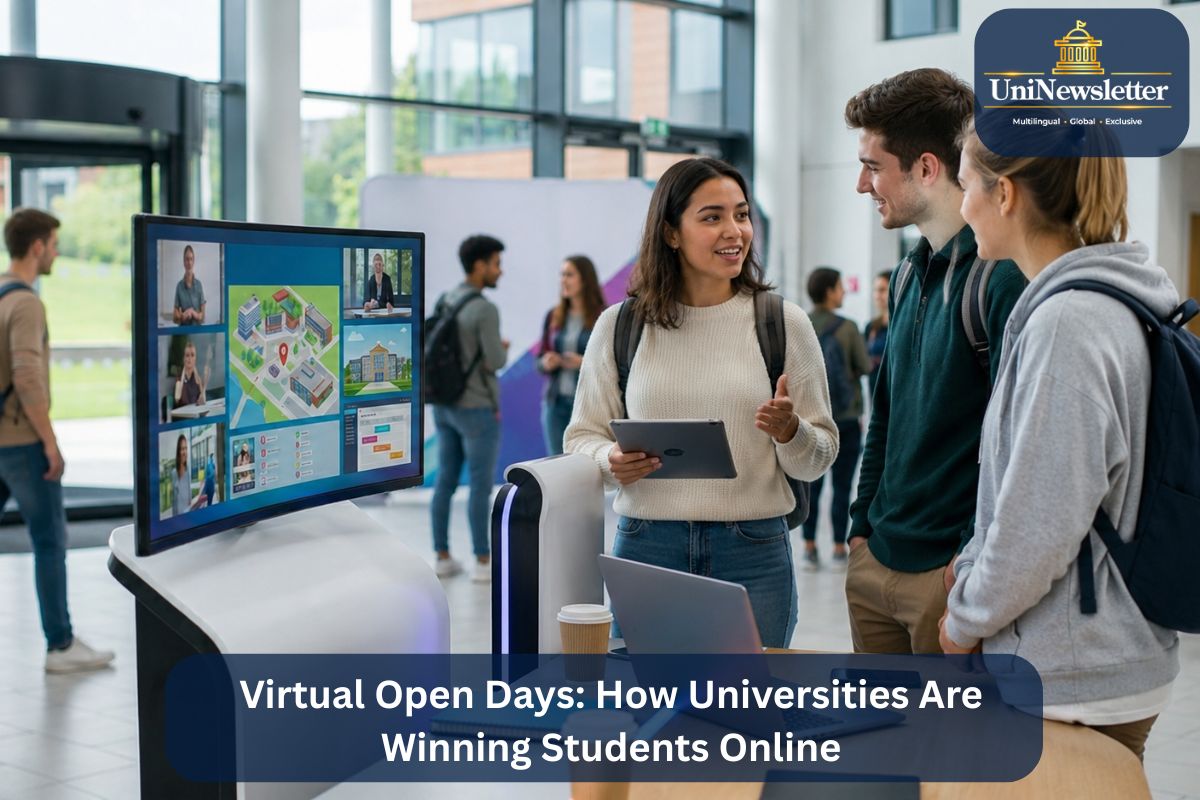
Virtual Open Days: How Universities Are Winning Students Online
Imagine what a student today actually does to choose a university. They don't go to a career fair and take home a brochure and send off a form. They research through Google, click their way around, go on YouTube campus tours at midnight, read college forum messages from students, and often
attend information sessions months before they make an inquiry to the admissions team.
This shift in how students research and decide is not new, but it has accelerated sharply.
Recent data shows
that 80% of graduate and professional program applicants extensively research institutions online before making any direct contact, a behaviour researchers now call "stealth shopping." Universities that do not meet these students online, early and with something genuinely useful, are simply
not in the conversation.
For international students especially, the stakes are even higher. These are students making decisions that involve years of their lives — and often a significant portion of their family's savings — to study in a country they may never have visited before. For them, a well-executed virtual
open day is far more than a convenience; it can be the moment that makes a
university
feel real and trustworthy.
At
UniNewsletter
, we see virtual engagement becoming one of the most influential factors in international student decision-making, helping institutions build confidence, connection, and credibility long before a student ever arrives on campus.
So What Is a Virtual Open Day, Really?
A virtual open day exists as an online version of a traditional campus event but its 2026 best events exceed this basic definition. The program offers live Q&A sessions with admissions personnel and current students, and pre-recorded department presentations, and
360-degree virtual campus tours
, which international students can use, and dedicated sessions that explain visa requirements and scholarships and campus life. The universities established permanent virtual spaces that students can access throughout the entire academic year.
But does any of this actually work?
The University of Kent calls their virtual open day "essential for international student recruitment." Parul University in India saw a 40% jump in applications in a single admissions cycle after integrating virtual campus tours. These are not isolated cases, they reflect a pattern playing out
across institutions globally.
According to
research by The Student Room
, when students were asked how they would make decisions about university, virtual campus tours and open days came out as the top factor (24%), ahead of in-person visits and comparison tools. And the number one thing students wanted from a virtual open day? The ability to speak directly with
current students studying their course.
Why This Matters So Much for Higher Education International Students
The Open Doors 2025 report
found that US universities alone hosted over 1.17 million international students in the 2024/25 academic year, contributing nearly $55 billion to the US economy. The world will experience a total of 9 million students moving between countries by the year 2030. The competition to attract these
students has become more difficult because Canada and the UK implemented stricter visa requirements while universities from all regions compete to attract international students. The university system benefits from its capacity to streamline decision-making processes which help international
students select their preferred options.
Geography used to be the biggest barrier. A student in Vietnam considering a university in the Netherlands had no practical way to experience campus life before committing. Virtual open day events solve that directly, no travel needed, and a university can present itself to thousands of
prospective students across dozens of countries at once. There is also a trust element.
For international students, the decision involves visa requirements, relocation, and significant financial commitment
. A generic brochure does not address any of that. A live virtual session with an international student coordinator and a financial aid advisor does.
85%+ of students research universities online before they ever contact an admissions team, and international students shortlist institutions based almost entirely on online content first.
What Goes Into a Successful Virtual Open Day
Not all virtual open days are created equal. Students are perfectly capable of telling the difference between an event that was genuinely designed for them and one that was thrown together as a checkbox exercise.
What actually makes the difference?
Live interaction is non-negotiable
Pre-recorded content is useful, but the single thing students consistently ask for is the ability to ask questions and get real answers. In The Student Room's polling,
23% of students said
speaking to current students on their course was the most important element of a virtual open day. Not slick production values, not polished presentations, actual human conversation.
Virtual campus tours that feel real
A flat video of a campus walk is not the same as a proper 360-degree virtual campus tour for international students. The interactive format, where students can choose where to go, zoom into spaces, and explore at their own pace, creates a much stronger sense of place. Universities like
Berkeley, Stanford, and Harvard have invested in this seriously, and it shows in engagement data.
Content built around international students' actual questions
International students face different issues than domestic students. The following six areas require special sessions because they need more explanation than a single statement can provide: visa processes, English language requirements, cost of living, scholarship availability, student support
services, and graduate employment rates. The most beneficial virtual open days for international students provide tailored decision-making support that helps them with their specific needs according to
Times Higher Education
.
Data and follow-up
Virtual events produce data which serves as their main advantage over actual events. Universities can see which sessions held attention, where students dropped off, what questions came up repeatedly, and which regions drove the most engagement. The information provides direct input to digital
student recruitment methods while assisting admissions staff in their efforts to contact students who showed interest but have not yet submitted applications.
Read more:
How Top Universities Track Their Global Reputation and Online Visibility
How Universities Are Using This in Their Recruitment Strategies
The universities getting this right are not treating virtual open days as a one-off event. The organization conducts monthly regional webinars while establishing permanent virtual spaces which include live chat and student ambassador services to create initial contact points before potential
in-person meetings. The standard approach has shifted to
hybrid models which combine online virtual admissions events
with in-person experiences instead of treating them as temporary solutions.
The peer element is where many institutions are seeing the biggest difference. A study by Intead and Unibuddy found that 57% of students said conversations with student ambassadors were the most helpful resource in their decision-making. Universities building that into their online university
open day events, rather than relying purely on institutional presentations, are seeing stronger conversion from interest to application.
Read more:
How International Students Can Improve Their Employability While Studying
The Challenges
It would be dishonest to present virtual open days as a straightforward win with no downsides. There are genuine challenges that universities are still working through.
Screen fatigue is real.
Students are sitting through a lot of online content, and an open day that feels like a series of PowerPoint slides presented over Zoom is not going to hold attention. Format matters enormously.
Time zones create headaches.
A live event scheduled for peak hours in Europe might fall at 3am for students in East Asia. The solution requires universities to use multiple session times together with on-demand recordings and asynchronous Q&A tools, but they need to organize their work in advance.
Technology access is not equal.
A 360-degree virtual tour requires decent internet connectivity. The students from Africa and South Asia experience internet problems which make it hard for them to use data-heavy virtual experiences. The best institutions think about this and offer lighter-weight alternatives alongside the
full experience.
Authenticity is hard to fake.
Students have the ability to recognize when a university presents itself with an artificial image instead of showing its actual operations to the public. The admissions staff delivers their material through scripted presentations which have a different impact from a student who is in their
second year. The institutions that use current students prominently and give them room to be honest tend to build more trust.
Best Practices Worth Borrowing
If you are working in university recruitment or admissions, here is what the evidence points to:
Run dedicated international student sessions, not just a general open day with an international FAQ tacked on at the end
Put current international students front and centre; their voices carry more weight than any institutional message
Invest in proper 360-degree campus tours; flat video is not the same thing
The system should record all content which should then be stored for instant access by students who study in different time zones.
The collected engagement information should serve as the basis for customising follow-up communication while generalised email blasts should be avoided.
The organisation should establish their virtual recruitment events as an ongoing yearly process which extends beyond the main admission periods.
Test different formats, a panel discussion with alumni from specific countries may outperform a general faculty presentation
Read more:
How Students Can Choose the Right Transnational Education Program
Where Is This All Heading?
A few things seem reasonably clear about where online university events for recruitment are going.
AI is beginning to play a role, chatbots that can answer student questions in multiple languages, personalised content that adjusts based on a student's course interest and country of origin, and predictive tools that help admissions teams identify which students are most likely to apply.
D2L's 2026 higher education trends report
identifies AI-driven personalisation and hybrid learning models as two of the defining forces shaping institutions this year.
The hybrid model which starts with virtual activities and ends with in-person events has become the standard practice for organizations. Students use virtual events to build an initial shortlist. The in-person visit, where it happens, becomes about confirming a decision they have largely
already made. This changes how universities should think about what each format needs to do.
Student mobility across countries continues to increase although some of the major destination countries have implemented restrictions on visa issuance. The
European Association for International Education
demands that educational institutions should develop new recruitment methods while establishing better online platforms to attract international talent because traditional English-speaking countries have made it more difficult to enter their markets.
International students who need to select universities from distant locations will find that a virtual open day which has been designed effectively will provide them with the best experience of actual campus presence. The task at hand carries a weighty obligation. Universities that treat
initial contact with students as crucial establish authentic relationships with future students who will visit their campuses which provides them an advantage over competing institutions.
The Bottom Line:
Virtual open days have moved well past being a COVID-era workaround. For higher education international students, they are often the primary way of experiencing a university before applying. Institutions that invest in making these events genuinely useful, not just informative, but personal,
interactive, and honest, are finding that the investment pays off in applications, enrolments, and the quality of the students they attract.
If you are a student currently evaluating universities, do not underestimate how much you can learn from a well-run virtual open day. And if you are on the recruitment side, the question is not whether to run them, it is whether yours is actually good enough.

 26-05-2023
American University of Ras Al Khaimah
26-05-2023
American University of Ras Al Khaimah


 Featured Video