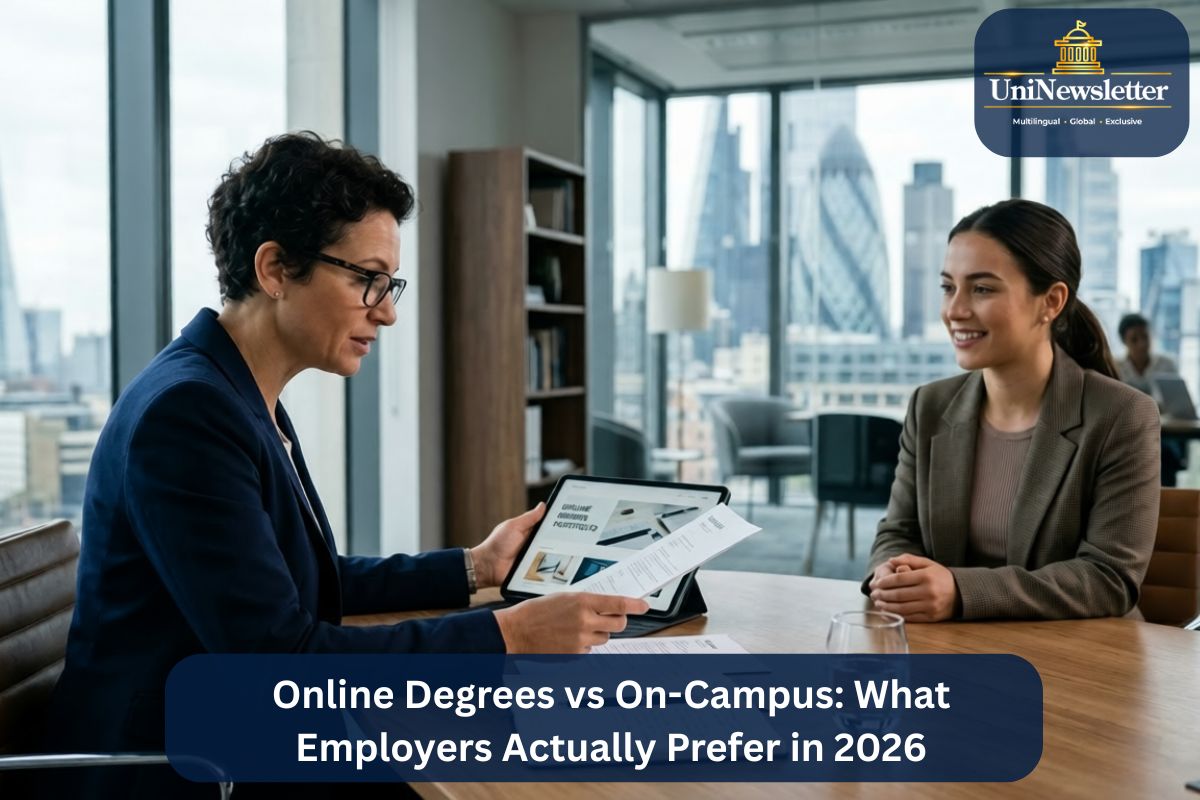
83% of employers now consider online degrees as credible as traditional on-campus programmes. Five years ago, that number would have seemed optimistic. So has the debate been settled, or does where you study still matter more than people admit?
The online degree vs on-campus degree question has changed a lot since 2020, maybe more than people realize. The pandemic made universities, employers, and students rethink what “learning” looks like, and a bunch of those updated assumptions have stuck around. The
World Economic Forum’s Future of Jobs Report
points to adaptability, digital fluency, and self-directed learning as the workplace skills most in demand through 2027, and online programmes happen to build those capabilities pretty directly. That’s not just luck. It’s part of why the conversation around online degrees has moved
forward.
But the honest answer about what employers actually prefer in 2026 is, it’s more nuanced than one tidy headline statistic. It depends on the industry, the institution, the specific role, and increasingly whether the employer is asking the question at all.
What Has Actually Changed in Employer Perception
The change in attitude among employers towards online education is tangible and quantifiable. Based on the 2026 employers analysis by
Research.com
, 72 percent of organisations hired candidates with online degrees in the previous year, while 83 percent believed online credentials were at parity with campus-based credentials obtained from regionally -accredited universities.The 2025 GMAC Corporate Recruiters Survey reported that 54
percent of global respondents said they value online and in-person degrees equally, compared to only 28 percent of US only employers 'preference for traditional education' a regional bias still present and far from resolved.
What drove this shift, well the pandemic normalised remote work and online collaboration at scale, making the skills developed through online study self discipline, digital communication, and asynchronous problem solving look less like workarounds . and more like genuine professional
capabilities. A
2025 study in the American Journal of Distance Education
confirmed that the pandemic significantly and lastingly altered employer perceptions of online versus traditional degrees during hiring, which is kind of the key.
That said 90% of employers still recognise online degrees during the hiring process, so yes the format gets noticed. The real question is if it counts against the candidate. Increasingly, it does not, but the institution, and accreditation still do.
The Factor That Matters More Than Format
If there's one finding that sort of cuts across all the research on this topic, it is this: the reputation and accreditation of the institution matters more than whether the degree was earned online or on campus. An online degree from a well regarded, accredited university carries more weight
than an on-campus degree from an unrecognised institution , even if both sound basically the same on paper. The delivery format is secondary to the credibility of the awarding body.
The second factor reshaping this whole debate is how hiring is getting more skills based.
NACE's Job Outlook 2026
survey found that 70% of employers now use skills based hiring practices, up from 65% the previous year. When employers are looking past the credential wrappers and screening for demonstrated competencies instead , the online versus on-campus distinction starts to wobble a lot. What really
counts is what the person can do, not which classroom or lecture hall they sat in.
For international students navigating these choices, the implications are significant. A well-chosen online programme from a globally recognised institution can be as employable, sometimes more so, than an on-campus degree from a lesser-known one. The degree is a signal of capability. Make
sure it signals the right things. As
some degrees deliver a stronger international return on investment
than others, the institution's global reputation should be part of any decision.
Where the Differences Still Show Up
The value of online degrees compared with traditional degrees isn't the same everywhere. Sector context still steers how employers interpret and weigh credentials.
Industry
Online Degree Reception
Key Consideration
Technology
Highly accepted, skills and portfolio matter most
Demonstrable technical output often outweighs credentials entirely
Business / Finance
Widely accepted at most firms; elite firms still prefer campus
Goldman Sachs, McKinsey still recruit heavily through campus pipelines
Healthcare
Partial, licensure requirements limit online options
Clinical experience cannot be replicated online; accreditation is critical
Education
83% of HR professionals consider accredited online education degrees equal
Accreditation and teaching licensure are the primary filters
Law / Government
More conservative, traditional credentials still preferred
Institutional prestige and in-person networks remain significant
Networking is where on campus education keeps a real, solid edge. Studying on campus builds in person ties with classmates, faculty, and recruiters that remote programmes are kind of unable to mirror, at least not in the same lived way.
BusinessBecause's 2025
employer survey found that about two thirds of employers thought on-campus graduates were more likely to show stronger leadership and communication skills, these things usually form through in person cooperation, group tasks, and face to face negotiation. The perception gap has shrunk though
it hasnt fully disappeared.
For international students especially, the campus experience carries additional weight. As
international students on campus face visibility and representation challenges
, physical presence still creates access to networks, employer events, and cultural integration that online study does not automatically provide.
The Hybrid Middle Ground
The most interesting development in 2026 is not the online vs on-campus binary, it is the growing middle ground between them. Hybrid learning models blended programmes and
microcredentials alongside traditional degrees
are kinda changing the way students stack their achievements, plus how employers look at those achievements. A student who finishes a core degree on campus and then adds online specialisation certificates in AI, data analytics, or project management might end up showing a more convincing
profile than doing only one of those options, you know.
Universities are responding.
Universities going global without campuses
are creating hybrid delivery models that maintain their institutional credibility but remove the logistics, opening up new regions to existing programmes that students previously had to move countries for.
What This Means if You Are Choosing Right Now
So the practical takeaways are fairly simple. Pick an accredited programme from a school with a solid global reputation; the delivery style matters less than the name attached to the degree. If you go online, don’t just watch lectures, actively assemble your portfolio, experience, and
professional network that campus study tends to provide almost by default. Take internships, show up at industry events, help on projects that people can actually see, and treat the degree like a launching point rather than the finish line.
The employers asking "online or on campus?" are becoming fewer. The ones asking "what can you actually do, and who taught you to do it?" are becoming more. That is the question worth preparing for.
Conclusion
The online degree vs. on-campus debate hasn’t really been “settled,” but it has unquestionably been reshaped in a major way. By 2026, employer perceptions of online qualifications have become increasingly positive — and that trend continues to strengthen. Factors such as accreditation and
institutional reputation now matter far more than the method of delivery itself. At the same time, the rise of skills-based hiring is steadily narrowing the credibility gap year after year. At
UniNewsletter
, we see international students asking a different question today. The decision is no longer simply, “Which format do employers prefer?” Instead, it has become: “Which programme, from which institution, best positions me for the career I’m trying to build?”

 26-05-2023
American University of Ras Al Khaimah
26-05-2023
American University of Ras Al Khaimah


 Featured Video