Are you still thinking of global expansion in terms of "bricks and mortar," or are you looking at the digital
horizon?
For decades, the international expansion playbook followed by higher education institutions focused on establishing
new campuses — acquiring land, investing heavily in infrastructure, and committing significant financial resources.
But the landscape has changed dramatically, and in 2026 the traditional “physical-first” model carries increasing
risk due to rising operational costs, evolving visa regulations, and rapidly advancing technology. At
UniNewsletter , we observe that many institutions are now
rethinking global expansion strategies, exploring digital delivery models and transnational partnerships that allow
universities to reach students beyond physical borders.
Today, the most successful International Students aren't just those sitting in lecture halls in London or Sydney;
they are part of a massive, global network of learners participating in borderless higher education models.
Universities are realizing that you don't need a physical foundation to build a global reputation. Recent data from
the
UNESCO 2026 Higher Education Trends Report suggests that the sector is expanding rapidly, with
over 269 million students worldwide looking for flexible, quality-assured learning options.
So, how exactly are the world’s leading institutions entering new education markets without campus constraints?
Let’s dive into the strategies that are redefining the academic map.
Why Universities Are Moving Away from Physical Infrastructure
Establishing a branch campus involves multiple risks which make it an extremely important business decision. The
process demands enormous financial investment and requires several years to understand local property regulations
while creating a base that becomes challenging to change when market conditions alter. The "Big Four" destinations
which include the US, UK, Canada and Australia continue to attract almost half of all international students but the
OECD
report Education at a Glance 2025 shows that student movement has now become subject to both policy
regulations and cost factors which compel universities to develop faster methods of reaching students.
Universities are now pivoting toward global university expansion strategies that prioritize agility. Educational
institutions can conduct market testing across multiple regions because they no longer need physical facilities,
which enables them to decrease costs when one area faces economic or political difficulties. The UK government has
established its educational export goal of £40 billion for 2030 through its current strategy which focuses on
Transnational Education (TNE) instead of only supporting local student enrollment.
Understanding Borderless Higher Education Models
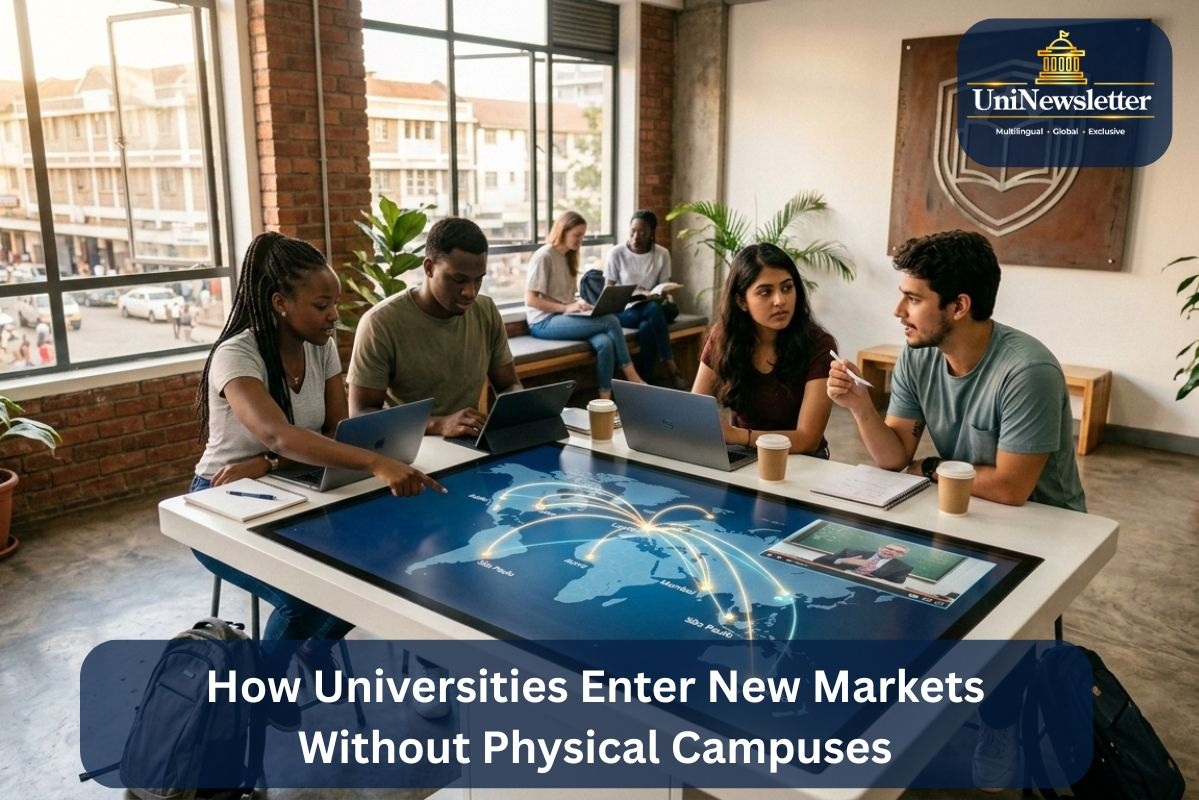
A borderless higher education model is a system where learning isn't tied to a specific GPS coordinate. This
approach treats education as a service that can be exported digitally.
The educational programs which universities create exist to attract students instead of requiring them to attend
classes on campus. The system provides more than "Zoom university" because it combines local assistance with online
testing facilities and self-paced study spaces. A student from Lagos can complete his degree program at a Berlin
university without needing to travel by airplane.
Key Market Entry Strategies for Universities
The universities use market entry strategies for universities through their physical expansion projects because
they need multiple entry methods to enter new markets.
1. Online Program Delivery in Target Markets
Through its online international education expansion, the university creates pathways for global students to access
its main academic programs. The student body now emphasizes "career-readiness" programs because they provide direct
links to job opportunities instead of educational results.
2. Strategic Recruitment Partnerships
Entering a new market is much easier with a local partner. Many institutions focus on international student
recruitment without branch campus hubs by partnering with local education providers who act as their "boots on the
ground" for marketing and student support.
3. Joint and Dual Degree Programs
The institution establishes its main educational strategy through cross-border partnerships which enable them to
deliver educational programs in multiple countries. The "home" institution establishes its partnership with a local
university to gain instant credibility which enables them to access existing students without building their own
educational facilities.
4. Franchise or Validation Agreements
The international university awards degrees to students despite the local institution delivering all program
courses. The model enables universities to expand their operations while keeping their brand name present in the
market.
For more on the hurdles of these markets, see our guide on the
top challenges universities face in entering new recruitment markets .
Virtual Campuses: More Than Just a Website
The digital virtual campus for international students serves as the essential digital "glue" which connects all
elements of the borderless educational system. The system provides a complete physical campus experience which
students can access through:
Immersive AR/VR Environments: Prospective and current students can "walk" through lecture halls and labs
via 3D panoramas, fostering a sense of belonging before they even enroll.
AI-Powered "Student Concierge": The 24/7 intelligent guides deliver personalized navigation together with
immediate response capabilities to student inquiries which replicate the experience of one-on-one counseling.
ICEF Monitor reports that AI is now a "readiness decision" for universities to maintain a
competitive edge in recruitment.
Virtual Digital Hubs: The platform provides students with virtual lounges which enable them to connect with
fellow students and faculty members and alumni through avatar-driven meetings and online discussion forums.
Gamified Learning Spaces: The creation of such gamified academic rigor through interactive challenges,
potentially supplying digital-native learners with productive learning experiences.
International Student Recruitment Without Branch Campuses
Recruiting International Students without a physical building requires a "Search Everywhere" optimization strategy.
Students in 2026 don't just use Google; they use generative AI tools like ChatGPT and Gemini to find the best
programs.
Universities need to organize their materials in a way that allowsAI "answer engines" to find and cite their work.
Authentic student voices now carry more weight than formal marketing materials because peer-to-peer content and
short-form video establish brand trust for new markets.
Technology as an Enabler of Global University Expansion
Technology is the engine behind online international education expansion. Cloud-based Learning Management Systems
(LMS) allow universities to manage thousands of learners simultaneously while reducing IT overhead.
However, technology also demands a new kind of marketing. You can’t rely on a local office to build trust. You need
a digital presence that feels local and authentic. This is why
localized content is key to attracting students in emerging markets .
Managing the Risks of Non-Physical Expansion
While "asset-light" expansion is more cost-effective, it comes with its own set of digital transnational education
models risks:
Infrastructure & Connectivity Gaps: Various host nations lack dependable electricity supply together
with high-speed internet connections. Power outages can disrupt exams and synchronous learning.
Licensing & Resource Restrictions: Software and digital library licenses often have strict geographic
boundaries which create costly challenges for universities that want to provide offshore students the same
resources as on-campus students.
Regulatory & Accreditation Hurdles: Many countries continue to enforce strict regulations which control
the approval process of online-only academic degrees. The
QS reports show that although the Indian market is expanding, traditional institutional
reputation remains a critical obstacle for non-physical market entry.
Cultural & Pedagogical Misalignment: Western audiences cannot connect with content that is designed
specifically for them. The curriculum needs localized content because different academic authority perceptions
result in diminished student participation.
To see how we help institutions navigate these waters, visit our
universities page for strategic insights.
The Future of Global University Expansion Strategies
The shift from infrastructure-led to digital-led expansion is permanent. Future global university expansion
strategies will focus on "Stackable Credentials", short, online courses that can eventually lead to a full degree.
According to
ApplyBoard’s 2026 Trends Report , investments in Transnational Education (TNE) are set to
increase as financial burdens force students toward more creative, low-cost solutions like blended or remote
programs. This evolution allows universities to remain globally relevant while minimizing the risks associated with
physical branch campuses.
Conclusion
The outdoor college space continues to exist today although it has lost its status as the sole method of college
attendance. Higher Education will become "borderless" in its future development.
Through digital transnational education models and strategic partnerships, educational institutions will gain
access to a larger pool of International Students than ever before. A global leader position does not require you to
own a skyscraper located in a foreign capital because you only need to establish a precise digital strategy.
The most successful universities of 2026 will achieve their success through virtual knowledge delivery rather than
their physical land ownership. For more insights on representing diverse voices in these models, read our article on
how
international students on campus are visible but not always represented .

 26-05-2023
American University of Ras Al Khaimah
26-05-2023
American University of Ras Al Khaimah


 Featured Video