Even now, if you're started Googling "when should I apply to study abroad" after 1 AM or you have at least
fifteen open browser tabs, you're not far from what most students should really be doing. A good application
timeline is probably the biggest factor that separates applicants who make it to their dream university from
those who can only accept what's available. As UNESCO's latest Higher Education Global Trends Reports , with the
figure of over 7.3 million foreign students still going up, the competition for university places, scholarships,
and visa appointments in many countries have reached an all-time high.
Actually the matter is simply this question: When do prospective international students need to start applying?
How do you come up with a schedule that won't disintegrate when a couple of deadlines catch you unprepared?
Well, these are issues we will definitely cover in this article. Take a coffee with you and join us as we
discuss when is the best time to apply for abroad programs, how long the optimal planning period is, and ways to
steer clear of the errors that may cause your schedule to slip by an entire year. At UniNewsletter , we're
committed to helping students and their families navigate the application process with reliable guidance,
practical timelines, and expert insights so they can plan their study abroad journey with confidence.
Why Starting Early Matters
University admissions and visa departments are moving fast. One thing to note is that application windows,
scholarship deadlines, and English test slots all proceed by their own calendars and it rarely happens that all
these events occur conveniently together. A slow beginning results in the availability of fewer courses, the
possibility of receiving fewer scholarly support, and a situation where you are trying to get a visa appointment
just before your intake closes.
Ever heard someone say "I'll apply in a couple of months, no rush," only to end up emailing five universities
months later asking if late applications are still open? It happens more than you'd think, and it's rarely a
talent problem, it's a timing one.
Higher education institutions abroad also process thousands of applications from international students every
cycle, and the ones submitted early simply get more attention, more time for document verification, and more
room for follow-up if something's missing. OECD's recent research on international students also notes a clear
tightening of policies across major destinations since 2024, which makes early, complete applications even more
important than before. Starting late doesn't just cost you time, it costs you options.
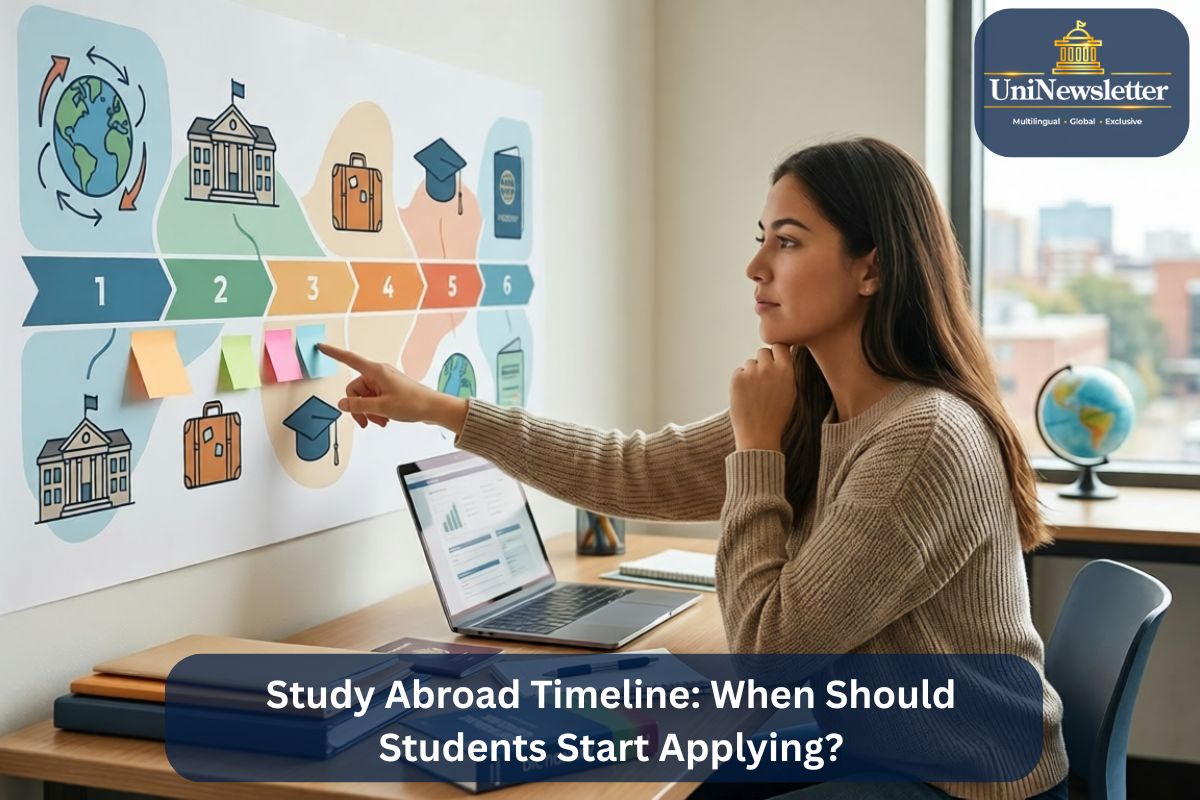
Ideal Study Abroad Timeline (12–18 Months Before Intake)
One thing with which most education Counsellors agree is this: the best time to apply for universities abroad is
between 12-18 months before your planned intake. That might seem like a good headstart, but when you look at how
time is taken to do the research, take the tests, submit the applications, get the offers and get the visas, the
gap is actually quite narrow.
View this more as one long process and less as a set date when you have to submit everything. Every single thing
in there is important - your whole university process depends on it!
12–18 Months Before Departure: Research and Goal Setting
This is where your study abroad planning timeline really begins, and it's the stage students rush through the
most. Why? Because there's no deadline breathing down your neck yet, which is exactly why it gets pushed aside
in favour of "I'll figure it out later."
Choose Course and Career Goals
Firstly you have to know really what kind of thing you intend to do your research upon and how the study can be a
way to the career of your wishes. Such a decision has huge influence on almost everything, so to name only a few
it will dictate countries which ones to focus on as well as universities to be considered at all.
Select Countries
Cost of living, post-study work permission, job prospects should all be factors in your decision. If the money
factor is quite dominant in your choice, our guide on study abroad trends .
Shortlist Universities
Once your course and country are set, narrow down 6-8 universities based on rankings, faculty, and course
structure. For a step-by-step approach, check out choosing the right university abroad.
Estimate Budget
What you have to pay apart from tuition fees may still be substantial. You need to count costs for housing and
daily living, insurance for health, and the proof-of-funds requirement which most visa offices ask for right the
first time.
10-12 Months Before Intake: Prepare for Tests
English test for competence e. g. IELTS or TOEFL, and when needed GRE or GMAT are required to be done well in
advance on the time required for learning. Since exam dates get occupied very soon during busy periods most
students also try once in a while to do better so a score retake is very common. Why not just take it once and
hope for the best? Because scores expire, retakes need weeks of gap between attempts, and universities won't
budge on their minimum score requirements. Book your first attempt now, and leave room for a second try before
deadlines close in.
8-10 Months Before Intake: University Applications
This is the starting point of getting your university application in order, a point at which international
students are advised to seriously focus on their timeline. University applications usually demand that you
present transcripts, a personal statement, recommendation letters, and test scores. These components are to be
submitted together so that missing only one could cause the delay of processing by weeks. Because of this, it is
better you create your file from an early stage rather than trying to find out what papers you are missing at
the time of the deadline. A little sorting and organizing at this moment could save you from major worrying
afterwards. We really mean that one.
6-8 Months Before Intake: Admission Offers and Scholarships
Offers typically start rolling in during this window, and this is a critical stretch in the study abroad
admission timeline. Scholarship deadlines often fall earlier than the main application deadline, so don't wait
for your offer letter before applying for funding. Many scholarships are awarded on a first-come basis, and late
applicants are routinely turned away regardless of merit.
3-6 Months Before Intake: Student Visa Applications
Once you have an unconditional offer, the visa clock starts. Processing times vary widely by country and have
shifted quite a bit recently. According to the UK government's official student visa guidance , standard
processing typically runs a few weeks, while Canada's official IRCC processing time tracker currently lists
study permit processing running several weeks to a few months depending on volume. Australia's Department of Home Affairs publishes updated visa processing times monthly, and it's worth checking these directly rather than
relying on outdated blog estimates. If you're applying from a country with additional documentation
requirements, our piece on common mistakes in study visa applications covers the errors that cause the most
delays.
1-3 Months Before Departure: Final Preparation
It would be good to do things like get bookings for your plane ticket, find somewhere to stay, have your health
checks done by the doctor, and attend pre-departure briefings that some universities offer. Here you also check
your academic schedule one by one with the official calendar that the university offers, in case you are going
somewhere with changes in the academic date recently, like the UAE's updated 2025-2026 academic calendar . After
receiving the visa, one might tend to think that the most complicated part is over, but still, some small
mistakes such as an expired passport or a forgotten insurance form can result in you getting into a tight
corner.
Study Abroad Timeline by Popular Intake
Intake
Typical
Start
Ideal
Application Window
Fall
(September)
September
December-March,
same year
Spring
(January)
January
June-September,
prior year
Summer
(May)
May
October-January,
prior year
Fall remains the most popular intake globally, with the widest course selection
and the most scholarship funding available. Spring and summer intakes suit students who need extra time for test
scores or documentation, or who simply discovered their dream program too late for Fall. Neither is a
"consolation prize", plenty of students genuinely prefer the smaller cohort sizes that come with Spring
intake.
Application Timeline by Country
Country
Fall
Intake Deadline Window
Visa
Processing Time
USA
December-January
Varies
by consulate, book early
UK
January-June
Typically
a few weeks
Canada
February-April
Several
weeks to a few months
Australia
September-November
(prior year)
Weeks,
updated monthly by authorities
Germany
July-September
(prior year)
Can
extend to a few months with appointments
Common Mistakes Students Make
We've seen the same handful of mistakes trip up students year after year. See if any of these sound a
little too familiar:
Waiting for a "perfect" university list instead of shortlisting early and refining as you go Treating the visa application as a formality instead of a process with its own deadline and its own
paperwork Ignoring scholarship deadlines that close before the main application does Booking English test slots too late for a retake, then panicking when the score falls short Underestimating how long document verification and legalization can take, especially for attested
transcripts None of these are dramatic mistakes, that's what makes them so common. They feel minor in the moment, right
up until they cost you an entire intake.
Study Abroad Preparation Checklist Shortlisted universities and courses finalized English proficiency test booked, with a buffer for a retake Academic transcripts and recommendation letters requested Budget and proof-of-funds documents in progress Scholarship applications tracked separately from university deadlines Visa document checklist reviewed against the destination country's official requirements Accommodation and pre-departure logistics planned Simple as it looks, this checklist is basically a condensed version of everything we've walked through
above. If you can honestly tick off every item here, you're in a genuinely strong position.
Explore verified
universities as you build out your shortlist, so you're comparing real programs and intake
dates rather than working off guesswork.
Frequently Asked Questions
When should students start applying to study abroad?
The period of about 12-18 months before your intended intake is enough to go through tests, the
applications, offers, and also the processes for visas, all in a smooth and timely way without having those
last minute pressures. How early should I take the IELTS?
Book it at least 10-12 months before your intake so you have time for a retake.
Can I apply one year in advance?
Yes, and for many destinations, it's the ideal timeline rather than an early one.
When should I apply for a student visa?
In about 3-6 months before the start of your intake youa will typically receive the unconditional offer.
How long does the application process take?
Generally, the international students' application process duration includes all stages from research and
application through to getting the visa, etc. and is about 12-18 months in total.
What happens if I miss deadlines?
You may need to shift to the next intake, lose scholarship eligibility, or settle for a shorter list of
available courses.
Conclusion
There is no shortcut but to have a good study abroad plan on a timeline. When are they going to apply?
International students could start with their applications 12-18 months in advance, taking each stage - from
researching to testing, applying offers, and ultimately, visas - as a sort of personal deadline instead of
thinking about it only when they start to panic. You should not be worried about the procedure because it is
so much easier if you do it early on and keep track of your deadlines on your own.
Fundamentally, the ones who make their dreams come true are not always the top scorers. It is the one who
was able to complete things correctly with their own pace at every stage. That means, in case you were
procrastinating in university shortlist creation or making a reservation for, take this as a hint to finally
kick start today.

 26-05-2023
American University of Ras Al Khaimah
26-05-2023
American University of Ras Al Khaimah


 Featured Video