If your university's strategic plan was created before the emergence of generative AI or the deep economic downturn
caused by the demographic cliff, does that mean that your plan is now a historical document instead of serving as a
guide for future growth?
This is the uncomfortable question currently circulating through faculty senates and boardrooms across the globe.
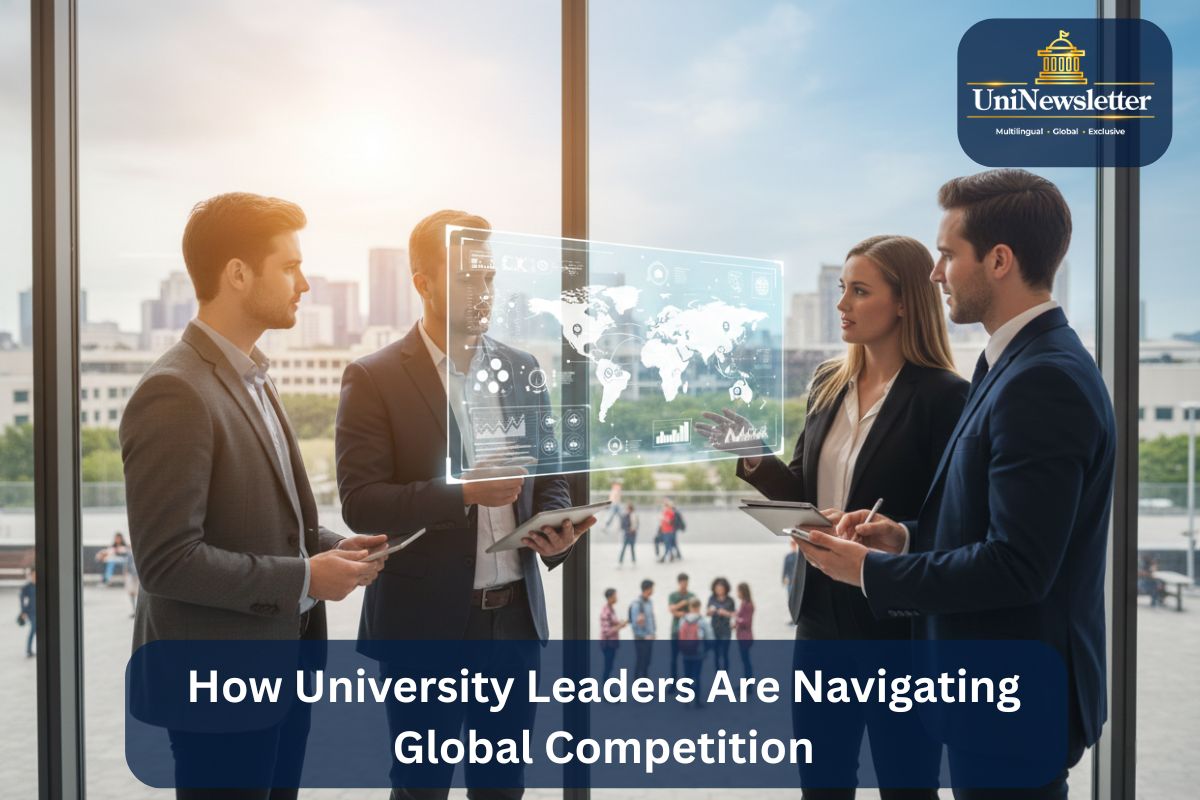
We have entered a period where the traditional "ivory tower" is being replaced by a hyper-connected, high-stakes
marketplace. The concept of global competition in higher education has moved beyond simple prestige; it is now a
matter of institutional survival. We are no longer merely competing with the university in the next state or the
adjacent province; we are competing for International Students against digital-first providers in Singapore,
research powerhouses in Germany, and the elite brands of the UK and US, all of whom are vying for the same shrinking
pool of elite talent.
At
UniNewsletter , we observe that this shift is no longer
abstract — it is redefining how institutions market themselves, structure academic offerings, and justify their
value on a global stage.
The Era of the Borderless Campus
The modern university is no longer defined by its physical boundaries. The shift toward a globalization impact on
universities has fundamentally altered how we define "the student." According to
UNESCO’s Institute for Statistics ,
the number of mobile students has more than doubled in the last two decades, but the destination preferences are
shifting.
Current university leaders will need to have a global university strategy that takes into account how today's
students are much more price-conscious, digital natives, and focused on their careers than previous generations of
students. Today's student does not just want a degree; they expect to receive a global ROI for their money invested
in a business degree program. The leader of an institution must ensure that their institution's brand is consistent
across cultures and different digital environments.
The Multi-Front Pressure on Leadership
The current climate of global higher education leadership is defined by three distinct "pressure cookers" that
require constant navigation:
1. The Financial Dependence Trap
Many institutions are walking a financial tightrope, having become overly dependent on international tuition fees
to subsidize domestic operations. As noted by
The Brookings Institution , this creates a precarious
vulnerability. Massive economic impacts can occur as a result of regional or national policies suddenly stopping
recruitment pipelines from certain parts of the world. These changes force strategic leaders to find new ways to
generate income for their institutions and to leverage long-term partnerships with organizations as well as the
development of educational models and opportunities through lifetime learning.
2. The Agility Gap
Traditional academic governance is designed for deliberation, not speed. However, market forces move at the speed
of light. Research from the
American Council on Education (ACE) highlights that the "agility gap", the time it takes for a
university to respond to industry needs, is the single greatest threat to institutional relevance.
3. Reputational Fragility in the Digital Age
In a world of instant global rankings and social media transparency, a single campus controversy or a dip in
research output can have immediate international consequences. Managing a university's reputation is now a 24/7
global PR effort.
How Universities Compete Globally: The New Playbook
So, how are the world’s most resilient institutions responding? They aren't just increasing their marketing spend;
they are reinventing the very nature of university leadership strategies.
Niche Authority vs. Generalist Mediocrity
The days of trying to be "everything to everyone" are over. Leading institutions are utilizing "pockets of
excellence" in their respective areas by concentrating their efforts on certain as we see it, this enables them to
gain an international reputation within an industry or market of potential interest to them, which allows for the
pursuit of funding and top faculty members for their respective programs. This strategy is explored in depth in our
analysis of
toward innovation, inclusion, and regional leadership , where we discuss how regional strengths
can be leveraged into global assets.
The Rise of Transnational Alliances
How universities compete globally for students is evolving from "branch campuses" to "deep-tissue partnerships."
These are not just exchange programs; they are integrated degrees where a student might spend two years in Mumbai
and two years in London, graduating with a joint credential. This reduces the barrier to entry for the student while
expanding the university’s footprint without the overhead of new construction.
Data as the New Endowment
The era of "gut-feeling" leadership is dead. Effective strategic leadership in universities now relies on
predictive analytics. From identifying which students are at risk of dropping out to predicting which global markets
will demand specific skills in five years, data is the engine of growth.
Harvard Business Review has pointed out that institutions using data
to personalize the student experience see significantly higher retention and satisfaction rates.
Higher Education Leadership Trends: Looking Toward 2030
As we look toward the end of the decade, several
Higher Education trends are emerging that will define the next generation of "winner" institutions:
Micro-credentials: The emergence of modular-based education is already affecting traditional higher
education institutions. Universities are competing more and more for the same student audience as some of the same
non-traditional organizations, such as Google and Coursera. In order to maintain relevance as student choice
increases, university leaders must incorporate certifications of industry-specific skills into their academic
curricula.
The Sustainability Mandate: Today's students are driven by values, and new research shows that the
commitment to the UN Sustainable Development Goals has now become one of the most critical factors when
considering where to study internationally (
Times Higher Education
Impact Rankings ).
AI-Augmented Administration: Outside of the classroom and within the university, AI is providing
institutions with efficiencies in the areas of Recruitment, Financial Aid & Student Support, allowing for
Human staff to focus on higher value interactions.
Strategic Leadership in Practice: Driving Innovation
Higher education institutions must shift from taking a “defensive” approach (protecting their current market) to
taking an “offensive” approach (creating their own future) in order to maximize competitiveness in the international
higher education marketplace. To do this, all higher education institutions must become innovators through
collaboration with one another and other stakeholders.
Leaders who silo themselves often miss the warning signs of market shifts. By engaging in
leadership forums to drive innovation , administrators can share the burden of R&D and
digital infrastructure costs. This collective intelligence is becoming a prerequisite for surviving the
international higher education competition.
Building the Resilient University
The goal for any board of governors should be "Institutional Resilience." A resilient university is one that can
withstand a 20% drop in international enrollment because its revenue is diversified. It is an institution where the
faculty are empowered to experiment with new pedagogy because the leadership has created a "safe to fail"
environment for innovation.
As the
World
Economic Forum aptly notes, the future of work is changing so rapidly that universities must transition from
being "finish lines" (where education ends at graduation) to "fueling stations" (where learners return throughout
their lives).
Key Takeaways for the Boardroom:
Audit your Agility: How long does it take to move a new degree program from concept to launch? If it’s more
than 18 months, you are losing to the market.
Diversify your Global Footprint: If 50% of your international students come from one country, you aren't
globally competitive, you are globally exposed.
Invest in Experience: In a borderless market, the "student experience" is your only real moat. Every
digital touchpoint must be as polished as the physical campus.
Final Thoughts: The Future is Shared
The "Global Competition" isn't a race with a single winner; it is an evolution of the entire sector. The
institutions that thrive will be those that stop viewing globalization as a threat and start viewing it as a
platform.
UniNewsletter has committed its resources to bring clarity to the connection between local/regional excellence and
leadership on a global scale. Through our various resources, leaders will gain access to information to assist in
fine-tuning their recruitment strategies and/or enhancing their digital presence. For more information, please visit
UniNewsletter Universities .
The ivory tower may have fallen, but the view from the global stage has never been better.

 26-05-2023
American University of Ras Al Khaimah
26-05-2023
American University of Ras Al Khaimah


 Featured Video