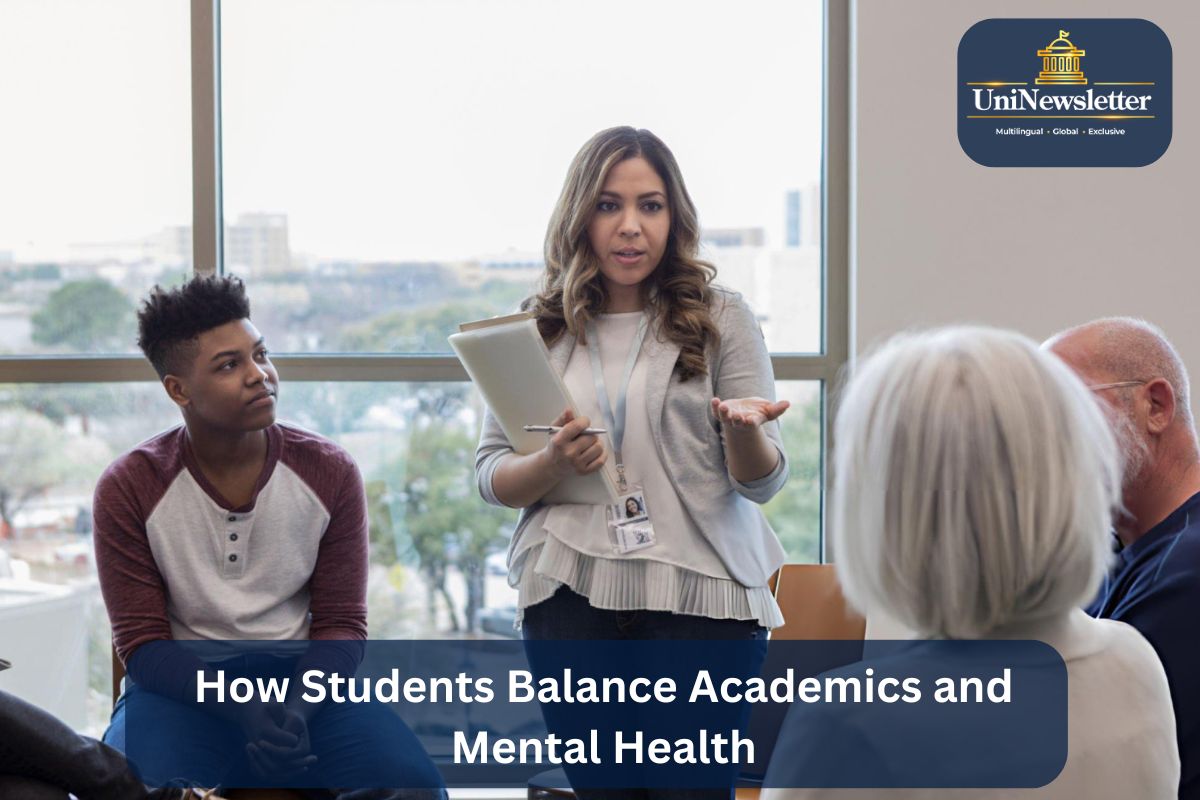
How Students Balance Academics and Mental Health
You've probably been in a university library and had an experience where there are hundreds of people and you are
feeling stressed but don't think about the people around you?
When looking at the university experience, particularly for
international students , marketing materials typically show it as an incredible experience with social events
and intellectual successes. Sadly, this is not the case for many, and many experience low-level lingering anxiety
during the university experience. We are living in a time where there is more pressure to "achieve" than ever;
however, we are only beginning to understand how we feel about our experiences as students.
In short, students’ mental health and academic performance go hand in hand; they are not minor aspects of
education. One cannot thrive while the other is in crisis. At
UniNewsletter , we explore how universities, policymakers,
and support systems are responding to this growing concern — because student success must be defined by well-being
as much as by grades.
Understanding the Weight of the Modern Degree
Now we have come to this point where the "typical" student experience has been replaced by a high-stakes
competition. It isn't just about passing exams anymore; it’s about securing internships, maintaining a perfect
social media presence, and justifying the rising costs of tuition.
As we understand this now, balancing academics and mental health is no longer a soft skill; it’s a survival
requirement. The most recent
Healthy Minds Study indicated that nearly 44% of
college students reported experiencing depression, with 37% reporting experiencing anxiety. The numerical scores
represent many millions of college students who face adversity through study hours, stress, and internal battles.
Common Mental Health Challenges for Students
When you think about the mental health challenges for students, mental health is more than just clinical
definitions. It often begins with what some people refer to as "imposter syndrome." Feeling like you truly don't
belong in your academic program and that everyone else is smarter than you.
For International Students, this is compounded by the
challenge of cultural adaptation and being thousands of miles away from a primary support
system. The academic stress and mental wellbeing of a student are often pulled in opposite directions by:
Digital Overload: The constant "ping" of notifications and the habit of comparing your "behind-the-scenes"
life to everyone else's "best-of" reel.
Financial Pressure: The weight of student loans and the need to work part-time while studying full-time.
Sleep Deprivation: Which we often wear as a badge of honor in university culture, despite it being a
primary trigger for mental health decline.
The Impact of Academics on Student Mental Health
Modern education is set up in such a way that it often encourages and rewards behaviours that eventually lead to
burnout. For example, we tend to recognise and reward the student who spends time in the lab until 4 AM. However,
very little attention is given to the potential impact of academics on a student's mental health until there is a
crisis.
Generally, the cycle of academic pressure and stress of the student is as follows: as a deadline approaches, the
student does not get enough sleep or nutrition to be able to meet the deadline; the student's adrenaline works to
get them through the deadline; and when the student has finished, they crash. When this same cycle repeats itself
every week for 3 years, the "good stress", which allows us to perform, turns into chronic stress; chronic stress
negatively affects the brain's ability to process and manage emotions. The
American Psychological
Association indicates that this constant stress has caused a record number of students to seek mental health
assistance, placing enormous pressure on the-student services of colleges and universities, which are already
strained by limited resources.
Why Mental Health is Essential in Education
We often hear about the importance of mental health in education, but why does it matter for the institution? Quite
simply, a student in crisis cannot learn.
As we understand this now, the brain’s "executive function", the part responsible for memory, focus, and
problem-solving, shuts down when it is in a state of high cortisol (the stress hormone). Universities can only
maintain high-performing students if mental health is prioritized. If a university does not care for the mental
health of students, it is akin to a manufacturing plant where the machinery and equipment are not maintained
appropriately resulting in the total shutdown of that entire process.
How Students Manage Stress in College
However, there is a bright side to these issues, students are strong. Most of the time when students experience
stress in college, their greatest resource for strategy is not that they require "more doing," it is that they
require "different doing."
Using examples of differing management of college stressors:
Micro disconnecting times – Students are now using one or two 10-minute periods of total disconnect
throughout their daily schedules instead of only having weekends to give themselves the opportunity to take a
break.
Radical Honesty – Moving away from the automatic response of "I'm fine" and instead letting friends or staff
know when things have become overwhelming.
Technology Boundaries: Students are implementing intentional boundaries with their technology by leaving
their devices in another room while studying in order to avoid comparing culture and the mental effort associated
with it.
According to
Mayo Clinic research , these types of small, regular rituals can be significantly more
effective at preventing burnout when compared to days of self-care.
Student Mental Health Support Strategies
It's now clear that 'self-help' won't cut it anymore; the university needs to embed student mental health support
strategies into its infrastructure. These strategies should include:
Peer support networks – Students should have a place to go to talk with another student who understands
their particular course pressures.
Counseling services should be accessible and have short wait times for immediate, short term crisis
interventions.
Inclusive support systems should be offered due to increasing
climate and health-related disruptions on student mobility and corresponding creation of
so-called new forms of "eco-anxiety" for this younger generation.
The Role of Universities in Mental Health Awareness
Universities hold the keys to the environment. They decide the workload, the grading scales, and the support
budget. The college mental health awareness movement is pushing institutions to realize that they aren't just
"degree factories."
There are organizations such as
Active Minds that are lobbying for universities to
incorporate information regarding mental wellness into the regular course of study so that students are aware of the
importance of developing the ability to withstand challenges and manage their emotions along with their education in
subjects like calculus or literature. It’s about
supporting the mental health of international students with the support needed to establish a
sense of belonging that goes beyond national borders.
Signs Students Should Not Ignore
To put it another way, your body usually realizes when things are wrong before your brain does. It is now
understood that there are many other obvious signs of mental distress, such as:
Lack of Interest: Participating in the hobbies and subjects you once enjoyed has become a tedious chore.
Withdrawal: You are finding ways to rationalize why you cannot spend time with your friends or family.
Physical Symptoms: You may have persistent headaches, stomach aches or other physical symptoms that often
accompany anxiety and you constantly feel as though you are "on edge".
The cost of having to do well in academics impacts your physical well-being too greatly. The
National Alliance For Mental Illness
indicates that intervening early is the key element to recovering from bad mental health episodes.
Building a Healthy Balance
The goal isn't to eliminate stress; that’s impossible in a high-performance environment like Higher Education. The
goal is to build a "healthy tension."
Academic success and mental health can coexist, but only if we stop treating them as competitors. This means:
Redefining Success: Understanding that a "B" and a healthy mind is a better outcome than an "A" and a
nervous breakdown.
Prioritizing Connection: Making time for people, not just for "networking," but for the sake of being
known.
Seeking Help Early: Utilizing the resources your university provides before the "stress" becomes
"distress."
A Final Perspective
When assessing the worth of your academic qualifications, do you determine the worth based on the grade stated on
your certificate or based upon the person you develop into through your schooling?
In simple terms, we are more than our GPAs. We are more than our future salaries. Now we have come to this: the
most important thing you will ever "manage" in university isn't your time or your projects, it’s your own humanity.
As we understand this now, the path to a better education system starts with the simple admission that it’s okay
not to be okay. When we disclose to the public that students are faced with academic pressure and mental stress, it
will no longer hold power over them.
Everything you have after you graduate is within your mind. Make sure you take care of it!

 26-05-2023
American University of Ras Al Khaimah
26-05-2023
American University of Ras Al Khaimah 


 Featured Video