Intra-Regional Student Mobility: Why More Students Are Staying Closer to Home
For decades, the direction of student movement in higher education has been fairly predictable: students from Asia, Africa, and the Global South head to the UK, USA, Australia, or Canada. The Big Four dominate. Everyone else competes for the remainder.
That picture is changing. Not dramatically overnight, but measurably and consistently.
UNESCO's initial Higher Education Global Trends Report
which came out in May 2026, validates the observation of many people working in the sector that intra-regional student mobility is on the rise. More and more students, Mainly from Asia, Africa, and the Arab world, are opting to study within their own region while less are traveling by sea to a
Western country. The reasons vary from being suitable to the situation, money wise, politics, and in some cases, personal reasons.
This blog breaks down what intra-regional mobility is, why it's happening now, which regions it's most visible in, and what it means for students making decisions in 2026.
What Is Intra-Regional Student Mobility?
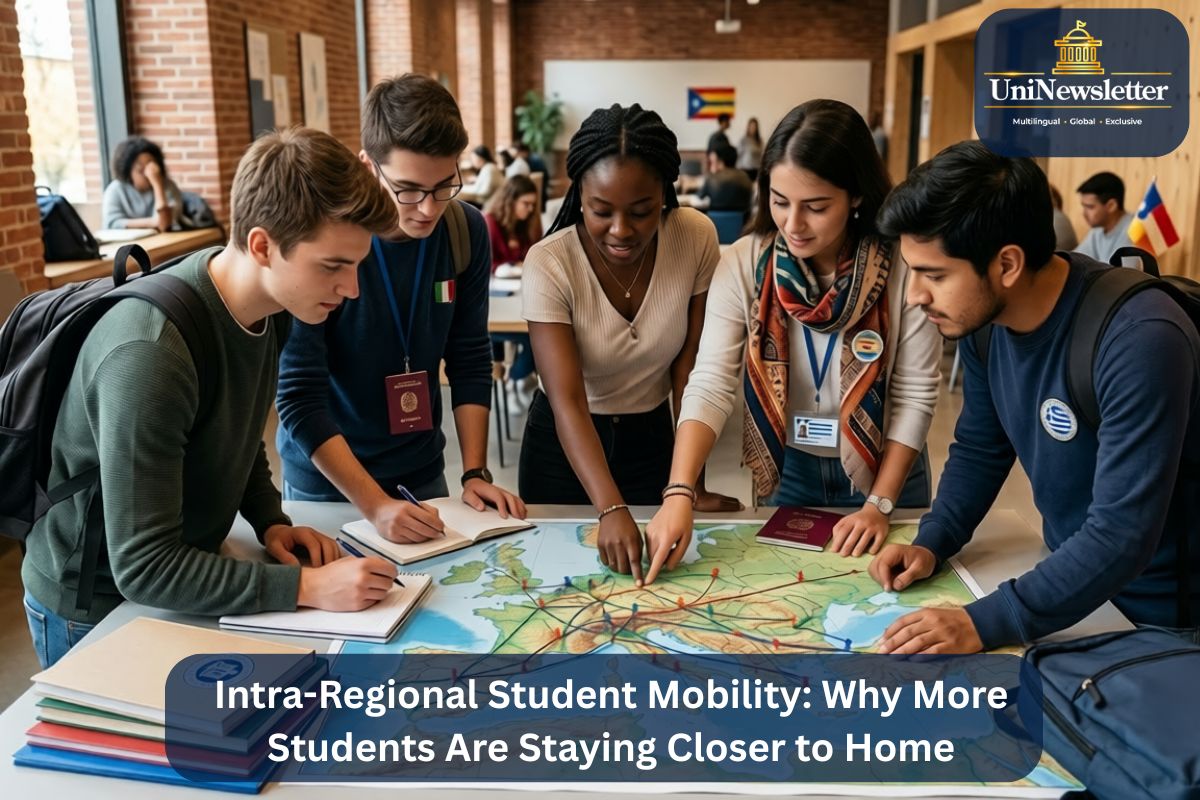
Intra-regional student mobility simply means students who travel to other countries for study, but within their regional boundaries only. A Kenyan student studying in Rwanda, a Pakistani student in university in Malaysia or an Indonesian graduate going to Japan, these are all examples.
It's still international study after all. The student still has to get familiar with a foreign system and will get the benefit of gaining cross-cultural experience. The difference is the destination is a neighboring country and not a traditional English-speaking institution located thousands
of miles away.
The SRHE Blog's February 2026 analysis
sums it up quite nicely: globally, although South-to-North mobility still represents the largest number of people, in the last fifteen years there has been a real competition to Western dominance, with new hubs becoming more and more visible and at the same time, intra-regional movements have
increased in several regions.
Why More Students Are Choosing to Study Closer to Home
No, it's not just a single reason, it's a combination that has been working in the background for many years and is now reflected in the enrollment figures.
Price:
The cost of students studying in the UK, USA, or Australia has dramatically increased, with tuition hikes, higher living expenses, and currency changes all together making the amount needed for a Western degree beyond the reach of many families. Regional alternatives in countries like
Malaysia, India, the UAE, or Turkey offer similar quality at much lower costs.
Visa issues and immigration policies:
The big four countries have Really restricted their policies. The US experienced a 20% reduction in new international student enrolments in the spring of 2026. Australia, Canada, and the UK have all implemented stricter visa quantity limits and reduced post-graduation work rights. Students who
are considering their options, the mere fact of uncertainty leads to a change of preferences.
Geopolitics and the impact of location changes on the choice of study abroad destination
have been the focus of
UniNewsletter
.
Improvements in the quality of local universities:
Satellite campuses of internationally ranked universities, more English-taught programmes, and higher research quality have transformed local options to be seriously capable competitors rather than just cheaper alternatives.
Cultural and Geographic Proximity:
shorter travel distances mean less money spent on transport, more opportunities for family visits, and fewer hassles when adapting to a new setting. Also the language barrier is a lot lower along many intra regional routes, which matters more than people expect.
Geopolitical and safety considerations:
political instability, plus worry about safety or discrimination in some destination countries, have turned into genuine decision factors. UniNewsletter’s piece on
how climate shocks and health crises are shaping international student mobility
, basically shows that non academic issues are starting to steer where students go, even when rankings look similar.
The Rise of Regional Education Hubs
QS Global Student Flows 2026 data
points to a pattern where students from South Asia, West Asia, and Sub-Saharan Africa are increasingly opting for nearby high quality institutions. This shift is supported by credit recognition systems that are spreading, as well as multilateral education agreements.
Here are some regional hubs worth your knowledge:
Malaysia -
Besides the low tuition fees, English-medium programmes, and more and more branch campuses, this country has students from all over East Asia and the Pacific. It is a perennial frontrunner for students from Indonesia and Bangladesh.
India -
Sub-Saharan Africa and South Asia have been the major sources of recruits for the Study in India initiative; currently, Indian universities' second largest foreign student population comes from African students.
Egypt -
Its Study in Egypt initiative, through scholarship schemes, assists students from Africa and the Arab States, Because of this Egypt has become a preferred destination for them.
Turkey -
Globally this is one of the top fastest expanding study locations. This country has a very strong appeal to regions like Central Asia, Middle East, and Africa.
UAE -
The more than 220,000 international enrollments, a continuously increasing number of branch campuses, and good post-graduation employment opportunities make this country not only a regional hub but also a global one.
Japan and South Korea -
Both countries are increasing the number of their students drawn from various parts of Asia using their scholarship programmes as well as expanding provision of English-medium courses.
How Universities Are Responding to Regional Mobility Trends
Universities in traditional destination countries are changing their ways to some extent rather than completely ignoring the shift:
Establishing regional campuses and collaborations -
Universities in UK, US, and Australia that have their main campuses abroad, are increasing the number of their branch campuses in the Middle East and Asia as a measure to remain accessible to students who may not be inclined to travel to the main campus for studies.
Refocusing recruitment strategy -
reallocating budget and effort in regions where students most desire a Western education but would be open to hybrid learning modes.
Creating articulation agreements -
officially recognized credit transfer routes between local colleges and leading universities.
Putting money into online and transnational education -
a mixed mode which enables students to study Western curricula while staying in their own countries.
Benefits of Regional Study Abroad Opportunities
Regional mobility isn't just a compromise, for many students it's a genuinely strong option. The benefits are real:
Lower overall cost -
tuition and living expenses in regional centers are, in most cases, just a fraction of the amounts students pay in the UK or Australia.
Cultural closeness -
shorter cultural as well as linguistic distances lead to students' easier adjustment and a Really improved experience.
Same global credentials -
branch campus degrees carry the same weight as those earned at the home institution
Career access in growing markets -
graduating with regional professional networks in the UAE or Malaysia is a strong position in fast-growing economies
Simpler visa pathways -
intra-regional routes are generally less complex and less uncertain than the Big Four
Challenges of Intra-Regional Student Mobility
The picture isn't entirely positive. There are real barriers that limit the growth of intra-regional mobility and affect the experience of students who pursue it.
Credit recognition gaps -
sometimes qualifications don't fully transfer from one system to the other. Without standardised setups, students who want to continue their education in different countries may face difficulties.
Brain drain -
student mobility within Africa largely leads students from poorer countries to more affluent neighbouring countries, thereby potentially increasing rather than reducing inequalities.
Quality inconsistency -
the quality of regional hubs differs a lot; some newly developing areas still do not have well recognized qualifications in the global job markets.
Limited scholarships -
Western countries have very well developed infrastructure for scholarships while many regional destinations are still in the process of setting up theirs.
Language barriers -
other than English-medium programmes in a few hubs, the language is really a barrier in many parts of Africa, Latin America and Asia.
How Student Migration Trends Are Reshaping Higher Education
A few shifts worth watching:
Declining revenue dependency on the Big Four -
Western universities built around high volumes of full-fee international students from China, India, and Nigeria are now operating in a more competitive environment
Investment in regional infrastructure -
governments across Asia, Africa, and the Middle East are building higher education capacity precisely to capture student flows that previously went West
Multipolar competition -
OECD Education at a Glance 2025
shows 86% of South Africa’s mobile students come from other African countries; meanwhile Latin American students choose nearby destinations with a lot of preference, and European students largely remain in Europe. Now these patterns are also spreading outward, and you can see it in how
recruitment is being reshaped.
Policy responses -
the nations that once assumed international students would always arrive are now doing something more deliberate, basically trying to keep their shine by improving visa procedures and making post graduation pathways far clearer, more livable.
The Future of Regional Student Mobility
QS projects the total international student population to reach 8.5 million by 2030
, with intra-regional mobility taking a growing share. The destinations getting better are the ones students are moving toward, it's that simple.
A few things that will speed this up:
Credit recognition frameworks -
as ASEAN, the African Union, and the Arab League develop standardised credit transfer agreements, cross-border study within regions gets easier to plan
Scholarship expansion -
as India, Turkey, and Egypt grow their programmes, they'll pull in larger and more diverse student populations
Continued policy tightening in the West -
unless the Big Four reverse course on immigration, the regional pull strengthens
Hybrid and digital learning -
models that let students access global curricula while staying in their home region will blur the line between intra-regional and fully remote study
For students evaluating where to go,
the countries worth considering in 2026
is a broader list than it's ever been, and the regional options on it are more serious than they used to be.
Conclusion
The Big Four aren't going anywhere, but their grip on international student flows is loosening. Cost, visa policy, rising regional quality, and genuine cultural preference are all pointing more students toward destinations closer to home, and that direction isn't reversing.
For higher education international students in 2026, the honest question is no longer just "where's the best university?" It's "where does quality, cost, location, and what comes after actually line up for me?" More students are finding that answer within their own region.
Explore universities across every region at the
UniNewsletter universities directory
.

 26-05-2023
American University of Ras Al Khaimah
26-05-2023
American University of Ras Al Khaimah 


 Featured Video