There's a particular kind of pride parents feel when their child gets accepted to a university abroad. And almost immediately after that pride, a very particular kind of worry.
Where will they live? How will they manage money? What if they get sick? What if they get homesick and nobody's nearby to help? These are not dramatic concerns. They're the natural response of a parent who cares, facing the reality that their child is about to take one of the biggest steps of their life, in another country, often another time zone, sometimes in a language that isn't their first.
The good news is that parents have the ability to influence the direction of this more than they might realize. It's not about controlling the whole process, but rather about being the right kind of support throughout. At UniNewsletter , we understand these concerns and aim to provide students and parents with reliable information, guidance, and insights that help make the international education journey more informed and manageable.
Why Parental Support Matters More Than Most People Realise Research makes this pretty clear. For example, in a 2025 article in Frontiers in Psychiatry , the authors underlined the compounded difficulties international students face as they live abroad for the first time. Usually without immediate practical support of family and friends, the students are left to handle independent living, new financial responsibilities and cultural adjustments, among other things, all of which they underestimate most of the time.
One research published in Scientific Reports determined that social support was the most powerful standalone determinant of international students' overall well-being apart from academic performance, language skills, and the country of study. In fact, family support, even if one is far away, still greatly influences student's adjustment and their feelings throughout the process.
And that is why it's so important: The first semester abroad is usually the one that presents the most difficulties. Students have to learn to combine an entirely new academic system, a social setting, living conditions, and usually a foreign language, too. The parents' role in this, if they are well-informed, deeply invested, and emotionally present even at a distance, is so powerful that it literally changes the results.
Helping Your Child Choose the Right University and Country This is what makes parental involvement crucial but quite frankly, it often goes wrong in this aspect. The typical error is deciding for the kids or pushing a certain country simply because the name sounds prestigious, ignoring Truth if it doesn't meet the actual needs.
The better approach is to help your child build a framework for the decision:
What field are they really interested in? Certain programmes clearly have their strengths in particular countries, for example, engineering in Germany, business in the US, creative arts in the UK, and medicine in Australia. Country choice should follow academic fit, not the reverse.
What do they actually want to study? Some programmes are genuinely stronger in specific countries, engineering in Germany, business in the US, creative arts in the UK, medicine in Australia. Country choice should follow academic fit, not the reverse.
What's the realistic cost? Tuition varies enormously. Germany and Norway offer low or no tuition at public universities. The US can run to $50,000 a year at private institutions. The price of living in a city such as London, Sydney or New York is much higher than in smaller university towns in Europe or Asia. Besides tuition fees, participating in an international study program entails other expenses like accommodation, food transport, and an emergency fund. Help your child draw a complete map of the expenses involved with their studying abroad.
What is the composition of the support system? Prestigious universities have hefty budgets for attracting and keeping international students. Because of this, apart from the campus and facilities, check if the university has a dedicated International Student Office, whether counseling services are available for non-native speakers, and if the university has a successful history of providing support to students from your child's country of origin.
Financial Planning for Parents of International Students Money is one of the major sources of concern for international students and one of the issues where parents have the room to make the most practical difference is in the pre-departure stage, not post-facto.
Work out a comprehensive budget together that includes tuition, accommodation, monthly living expenses, health insurance, visa fees, flights home, and an emergency reserve of at least two to three months of living costs. After that, increase your total amount by 15% as during the first year there will always be some unexpected circumstances.
Set up reliable money transfer systems before they leave. International transfer fees and currency conversion costs add up significantly over a year, services like Wise (formerly TransferWise) or Revolut offer dramatically better rates than traditional bank transfers. Help your child open a local bank account in the destination country as soon as possible after arrival; this alone saves money every month.
Agree on how often you'll send money and how much, and build in a buffer so they're not calling you in a panic every time an unexpected cost appears. The financial conversations you have before they leave are much less stressful than the ones you have mid-semester when the money has run out.
Document Preparation - the Checklist Parents Actually Need Getting the paperwork right before departure prevents a disproportionate amount of stress. Help your child prepare and keep copies of:
Valid passport (check the expiry date, many countries require validity for six months beyond the study period) Student visa and all associated documentation University acceptance letter and enrolment confirmation Health insurance documents, both the policy details and any emergency contact numbers Emergency contacts list, university international office, local embassy or consulate, family members back home Bank account details and access to emergency funds Housing contract or confirmed accommodation details Keep digital copies of all of these stored in a shared cloud folder that both you and your child can access. If a wallet gets stolen or a laptop goes missing, the documents are still recoverable.
Supporting Your Child Emotionally, From a Distance This is where many parents either try to do too much or pull back too far.
Per the research published in PMC/General Psychiatry that followed US international students from 2015 to 2024, the isolation from familiar support systems is one of the strongest predictors of anxiety and depression abroad Yet the same study indicates that students who feel overly controlled by their parents from home have more trouble in gaining the independence that study abroad is meant to foster.
The balance that works: a regular, planned contact rather than total availability. Set a weekly video call schedule, something predictable that both of you will rely on, instead of numerous check-in messages during the day that make both of you anxious. When you chat, inquire about their adventures, what they have seen, who they have met, what has been surprising to them, besides just talking about grades and whether they are eating properly.
Students worry about language barriers and cultural gaps among other things before they leave, recognizing that you are interested in their experience instead of only checking their academic performance, will give them something nice to share with you.
Send the occasional care package. Include things from home that can't be easily found abroad, specific foods, family photos, something personal. It may seem insignificant, but getting a tangible item from home has the effect of a video call quite that it cannot.
Helping Your Child Adjust to a New Country The adjustment process takes longer than most families expect. Three to six months is normal before a student starts genuinely feeling at home somewhere new, and the first month or two can be genuinely rough even for students who are excited about going.
Cultural adaptation is a skill that can be trained, it is not an inherent personality trait , and parents can actually be the catalysts for it at home by showing their children how. Say YES to student societies or sports clubs and explain that such activity is the steepest route of building a social network in a new place. Encourage your child to explore instead of retreating to the comforts of familiar food, familiar online spaces, and familiar people from their home country. Such comfort-seeking, of course, is totally understandable, yet it slows one's adjusting at times.
If your kid has some difficulties after the first month, definitely take them into consideration but you shouldn't worry. Not being able to easily change oneself are the normal and expected things for the first few weeks. If it is still difficult after two or three months, or if severe anxiety or depression come into the picture, then it is time to address these issues using the university's counseling services.
Safety Conversations Worth Having Before Departure These conversations are easier to have before departure than mid-crisis.
Cover the basics: being fully aware of the local address and how to reach out to local emergency services (the number for emergency calls is different in most countries), being totally familiar with one's immediate neighbourhood and being able to go around safely at night, having a way to get in touch with one's university's emergency support line.
Ensure that they have their home country's embassy or consulate number saved somewhere reachable, not only in their phone where it can be lost or stolen. Talk about digital safety as well: the scams targeting international students are (a) fake accommodation listings, (b) fake landlords, (c) Western Union payment requests, etc. and once you know what signs to look for, you can of course avoid most of these.
What Parents Should Avoid A few patterns that consistently make the study abroad experience harder:
Calling too frequently. Texting your child multiple times a day only creates anxiety not reassurance. It tells your child that you do not trust them to manage and you are also giving them less time and opportunity to develop the patterns and connections that result in genuine adjustment.
Treating every difficulty as a crisis. Yes, your child will be making these calls at times when they are upset or overwhelmed or experiencing homesickness. Makes sense. Though, not each tough week necessitates an intervention. Doing so makes your child comfortable with discomfort and enables them to gain valuable life skills they can even use outside of the context of study abroad.
Comparing their experience to an idealised version. What they're living is messy and real. It won't always match the brochure version of study abroad. That's fine.
Getting in their way when they want to use the university support services. According to TimelyCare's research on international student wellbeing , students are far less likely to use counselling services even when they definitely need help, partly because parents at home dismiss the difficulty or suggest that they "push through it". If your child tells you they are having a hard time, please show them the way to a counsellor. They should not be ashamed; this is what the system is for.
Before They Leave - A Practical Checklist The weeks before departure move faster than anyone expects. The 2025 study by NACAC on international student decision-making continually shows that families who do the practical preparations together before departure, end up having smoother first-semester transitions. Go through this list with your child before leaving, not last night, but with enough time to fix any missing items.
Full budget drafted and agreed Emergency fund established (separate from monthly allowance) All documents prepared and copied digitally International money transfer method set up Health insurance arranged and documents accessible Local SIM card or international data plan sorted University international student office contact details saved Regular call schedule agreed Local emergency numbers discussed and saved Care package planned for the first few weeks Conclusion Is studying abroad actually worth it ? For the vast majority of students who do it, the answer is yes, and the role parents play in how successfully that goes is larger than most people account for. The parents who support best are the ones who prepare thoroughly before departure and then trust their child to live the experience.
If you're helping a student find the right international university, UniNewsletter connects students and families with universities around the world , a good starting point for the research phase before any of this planning begins.
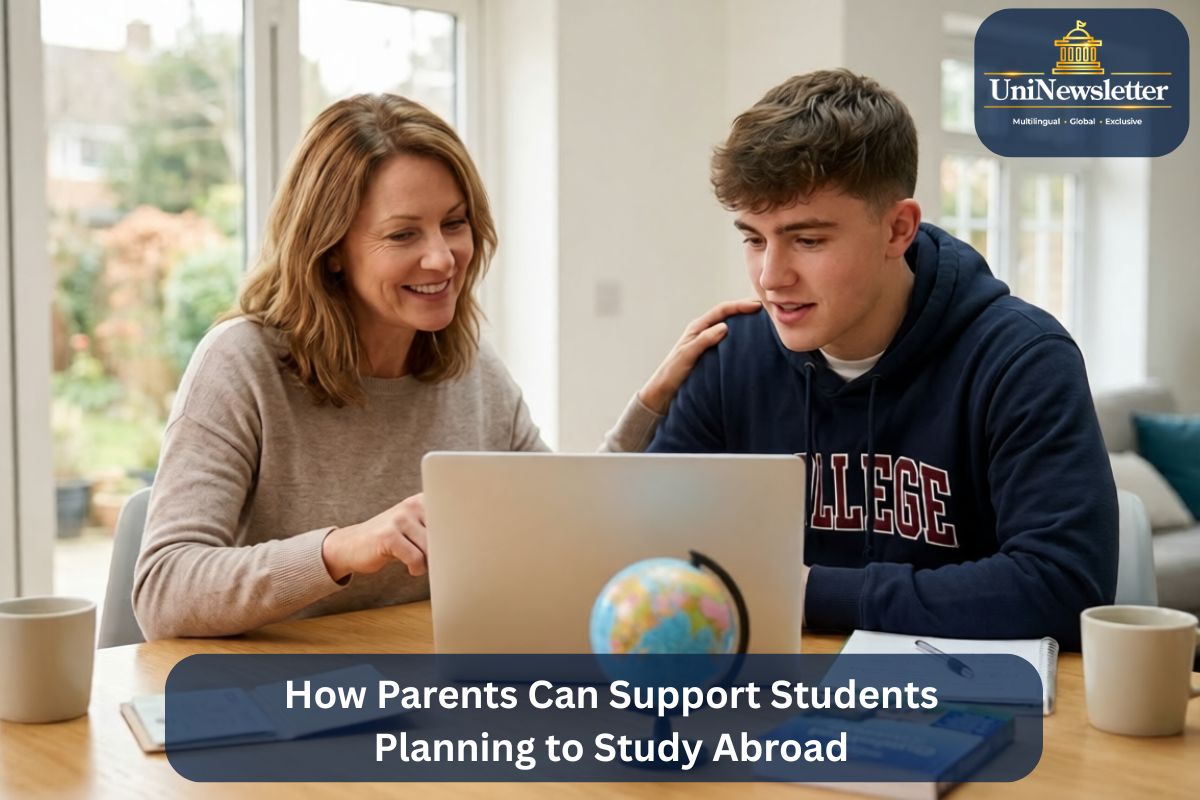
Frequently Asked Questions How can parents support students studying abroad?
Stay regularly in contact on an agreed schedule, help with financial planning before departure, prepare documents together, and be emotionally available without overmanaging. The best support is present but not overbearing.
How often should parents communicate with their child abroad?
Most families find a weekly video call very convenient. Contact every day, Then again, quite often creates more tension than it actually alleviates; it is a sign of mistrust and makes it difficult for the students to develop the independence that is a great feature of such an experience.
What financial planning should parents do before their child leaves?
Prepare a complete budget for the tuition accommodation living expenses, health insurance, and emergency fund. Establish a trustworthy international money transfer method and assist your child in getting a local bank account in the destination country either before or immediately after arrival.
How can parents help with homesickness?
Regular scheduled calls, care packages with familiar items from home, and encouragement to join social activities and explore the new environment. Normalise the difficulty of the first few months, it's expected, and it passes.
What safety measures should parents discuss before departure?
Emergency services numbers locally, embassy contact of the home country, awareness of common scams against international students, digital safety, and how to technically and safely explore the local neighbourhood. Discuss these points before departure rather than after an issue occurs.

 26-05-2023
American University of Ras Al Khaimah
26-05-2023
American University of Ras Al Khaimah


 Featured Video