Have you ever spent a significant portion of your budget on a high-performing digital ad campaign, seen the traffic
numbers spike on your dashboard, but then noticed that your actual application numbers barely moved? It’s a
frustratingly common scenario in Higher Education. We often treat the website as a digital brochure, a place to look
pretty and host mission statements, when it should actually be a high-performance engine for recruitment. When a
student from Mumbai, Lagos, or Sao Paulo lands on your page, they aren't looking for a "brand experience"; they are
looking for a reason to trust you with their future.
The "before" state for many institutions is a website that looks great but acts as a maze. The "after" state is a
streamlined journey that removes "decision friction." If your site isn't converting, it usually isn't an interest
problem; it's a "pathway" problem. Understanding why university websites fail to convert is the first step toward
reclaiming your marketing ROI and building a resilient international cohort.
At
UniNewsletter , we analyse these digital challenges and
their impact on global recruitment performance. Let’s explore the specific university website conversion issues that
prevent international students from clicking that crucial “Apply” button.
How International Students Use University Websites
We often make the mistake of assuming international students navigate a site the same way a domestic student does.
They don't. A domestic student might already be familiar with your city or your national reputation. An
international student is often starting from zero. They are navigating your site through a lens of high stakes and
high anxiety.
For them, the website is the "source of truth." Students require more than course information because they want
evidence that proves safety measures exist together with details about visa processes and information about job
prospects. According to research by
QS Quacquarelli Symonds , nearly 60% of international students say
that a university's website is the single most influential resource in their decision-making process. If that
resource is confusing, they don't just get frustrated; they leave.
Major University Website Conversion Issues
The most common university websites conversion issues rarely stem from a lack of information; they stem from a lack
of accessible information.
Many international student recruitment websites suffer from "Departmental Silos." The admissions information is in
one place, the scholarship details are in another, and the "student life" stories are buried in a blog. For a
student trying to calculate the total cost of their education, this fragmentation creates a high cognitive load.
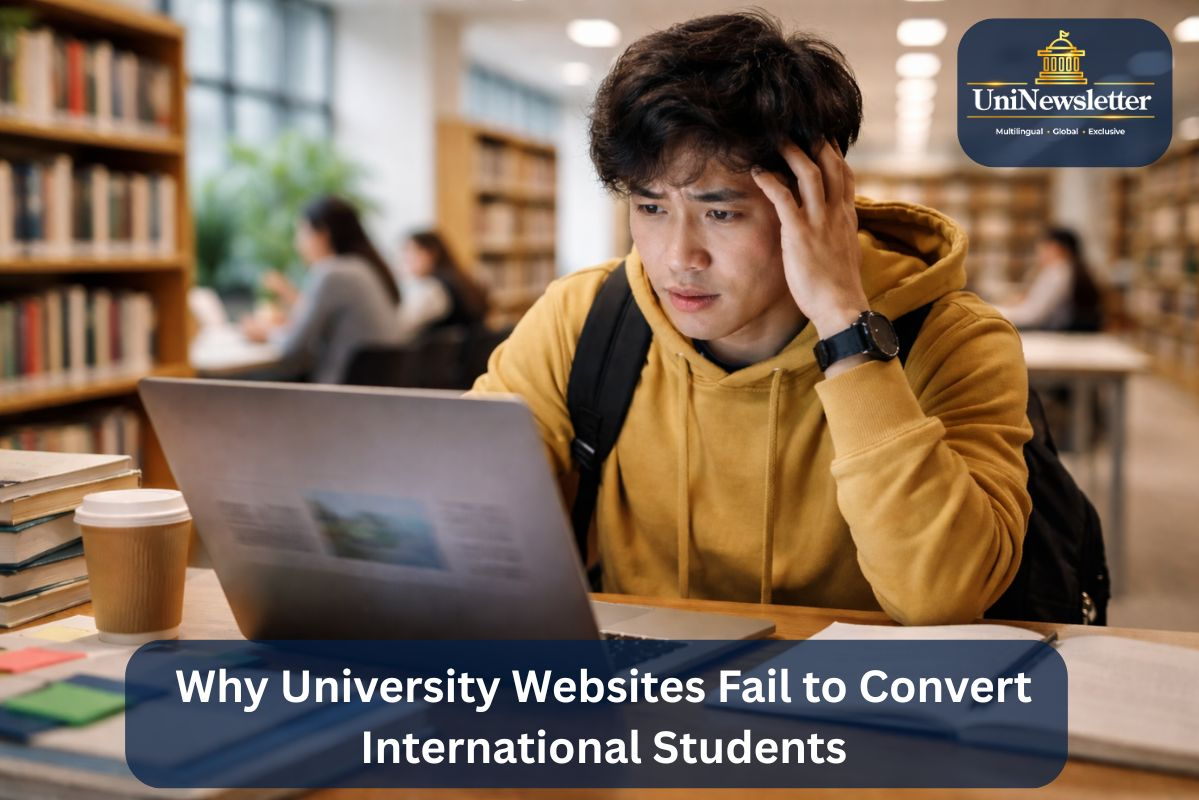
When a student has to open fifteen tabs just to understand if they can afford your tuition, you are creating
"conversion friction."
User Experience Issues That Block International Students
If we look at university website user experience issues, the biggest culprit is often "clutter." In an attempt to
please every faculty member and dean, homepages become a dumping ground for news and events that don't matter to a
prospective applicant.
Higher education website optimization requires a "student-first" hierarchy.
Mobile-First Reality: Students in many emerging markets access the internet through mobile devices which
experience variable data connection speeds. The student will leave your site before the page loads if your site
has "heavy" content which is not designed for mobile devices.
The "Search" Problem: If your internal search bar doesn't work perfectly, the student is gone.
Nielsen Norman Group highlights that
search-dominant users are often your highest-intent leads; if they can't find a specific course name, they assume
you don't offer it.
Trust Gaps on International Student Recruitment Websites
Trust is the currency of international student website conversion. A student moving 5,000 miles away is terrified
of making the wrong choice.
The website needs to display professional photography together with polished marketing content because it follows a
"brand-first" design. Students want to see "the real thing." This is where
building a strong global brand through digital content becomes vital. They want to see videos
of current international students, hear about actual job placements, and see the reality of the dorm rooms. If your
site feels like a "sales pitch" rather than a community, you will face significant international student website
conversion drops.
Content Mistakes Universities Make Online
Why do so many sites fail? Because they talk about "The University" rather than "The Student’s Journey."
Hidden Costs: Not being transparent about the "total cost of attendance" (including housing and insurance)
is a major reason why university websites fail to convert.
Generic Messaging: If your site looks exactly like every other university in your region, you haven't given
them a reason to choose you.
Poor CTAs: "Request More Information" is a weak Call to Action. "Download Your International Student Guide"
is a value proposition.
By
investing in long-term digital brand visibility , you ensure that your content isn't just a
placeholder, but a persuasive tool.
Why “Good Design” Alone Doesn’t Convert
You can have the most beautiful, award-winning university website design for international students, but if it
doesn't lead them to the next step, it is a failed investment. Education website conversion rate optimization (CRO)
is about removing the "Maybe later" and replacing it with "Apply now."
This involves
localized digital campaigns that speak to specific regional concerns. A student in China has
different questions than a student in India. If your website treats "International" as one giant bucket, you are
missing the nuances that drive conversion.
How Universities Can Improve International Student Website Conversion
Fixing your conversion rate isn't about a total redesign; it's about "intelligent tweaks."
Simplify the Funnel: The system needs fewer clicks to access the "Requirements" and "Fees" pages.
Add Trust Signals: The system should display third-party rankings and student testimonials as its primary
trust indicators.
Humanize the Interface: Use live chat or "Ask a Student" features to bridge the gap between a static screen
and a real person.
Optimize for Global SEO: Ensure you are answering the questions students are actually typing into Google,
as seen in our guide on how
students choose universities in the digital age .
According to
Google’s "Path to Purchase" studies , the research
phase for an international student can last 12 to 18 months. Your website needs to be a "hub" for that entire
duration, as discussed in our look at
academic engagement in the digital era .
Role of Website Optimization in Global Student Recruitment
Ultimately, your website is your 24/7 recruitment agent. If that agent is confusing, slow, or impersonal, your
recruitment will suffer. Effective higher education website optimization is an ongoing process of testing, learning,
and refining.
The institutions that are winning their competition have stopped using a "set it and forget it" approach. The
organization uses data analysis to identify student departure points while they proceed to develop navigation
systems that will assist students first before considering their internal decision-making processes.
Conclusion
The university website exists to achieve more than delivering information according to its main purpose of
motivating people to take action. The university website conversion problems become visible when you attempt to
solve them through direct methods because you lose valuable students who experience digital fatigue. Your website
transforms into your strongest asset for attracting new students when you design it with trust and clarity and
mobile-first accessibility.
At UniNewsletter, we help
universities see their digital presence through
the eyes of the student. The future of recruitment isn't just about who has the best campus; it's about who has the
clearest digital path to it.

 26-05-2023
American University of Ras Al Khaimah
26-05-2023
American University of Ras Al Khaimah


 Featured Video