Are you actually building a brand overseas, or are you just buying leads that never convert?
In higher education, international recruitment numbers often look impressive on a spreadsheet — thousands of
inquiries, hundreds of applications, and busy recruitment fairs in cities across the world. But when you look closer
at the data in 2026, the reality often tells a different story. Conversion rates are declining, and the cost per
acquisition continues to rise. Why? Because international students in emerging markets are increasingly tired of
being “sold” to.
At
UniNewsletter , we see that trust has become the most
valuable currency in global student recruitment. In regions such as Southeast Asia, Africa, and Latin America,
credibility and transparency often matter more than aggressive marketing campaigns. Universities that focus on
building authentic relationships and providing meaningful information are far more likely to earn the confidence of
prospective students and their families.
Trust, in many ways, has become the true foundation of international education partnerships — and institutions that
understand this shift will be better positioned to succeed in the evolving global landscape.
According to research by
ICEF Monitor , students from emerging economies now
prioritize "institutional reputation" and "local validation" above almost any other factor when choosing a study
destination. They aren't looking for your ads; they are looking for someone they already trust to vouch for you.
This is exactly why university media partnerships have become a mechanical necessity for global growth. It’s the
difference between shouting into a void and having a seat at the table.
Overview of Emerging Markets in 2026
The primary objective for educational leaders in global institutions today involves developing their presence in
new international markets. The process of entering markets like Vietnam or Nigeria becomes extremely difficult when
organizations lack a local "anchor" resource. The emerging markets university strategy which depends only on social
media algorithms fails because it disregards the vital role of cultural information gatekeepers. Strategic media
partnerships provide essential support to organizations because they transform foreign names into reliable domestic
brands by using established news and education platforms to build credibility.
Challenges Universities Face in Emerging Markets
The truth about emerging markets shows that these markets present significant challenges for business expansion.
The barriers which obstruct the development of business in Vietnam, Indonesia and Nigeria exist beyond physical
boundaries because they also include mental constraints.
Limited brand awareness
Unless you are a top-tier Ivy League or Oxbridge school, most families in emerging regions haven't heard of you.
You are starting from zero. Building that awareness through traditional PR takes decades; media partnerships
accelerate that timeline to months.
Trust and credibility gaps
For a family in an emerging market, sending a child abroad is a massive financial and emotional risk. They need to
know you are "real." Local media validation provides that "stamp of approval" that a brochure simply cannot.
Cultural and language barriers
The correct tone needs to be identified because it is difficult to determine which tone fits appropriate content.
Western messaging fails to connect with markets that prioritize community ties and enduring relationships because it
displays unapproachable corporate demeanor. This obstacle represents the main challenge which
international higher education institutions must overcome to establish their operations
worldwide.
Strong local and international competition
You aren't just competing with the university down the road; you’re competing with every high-ranking institution
globally that has realized the potential of these regions.
What Are University Media Partnerships?
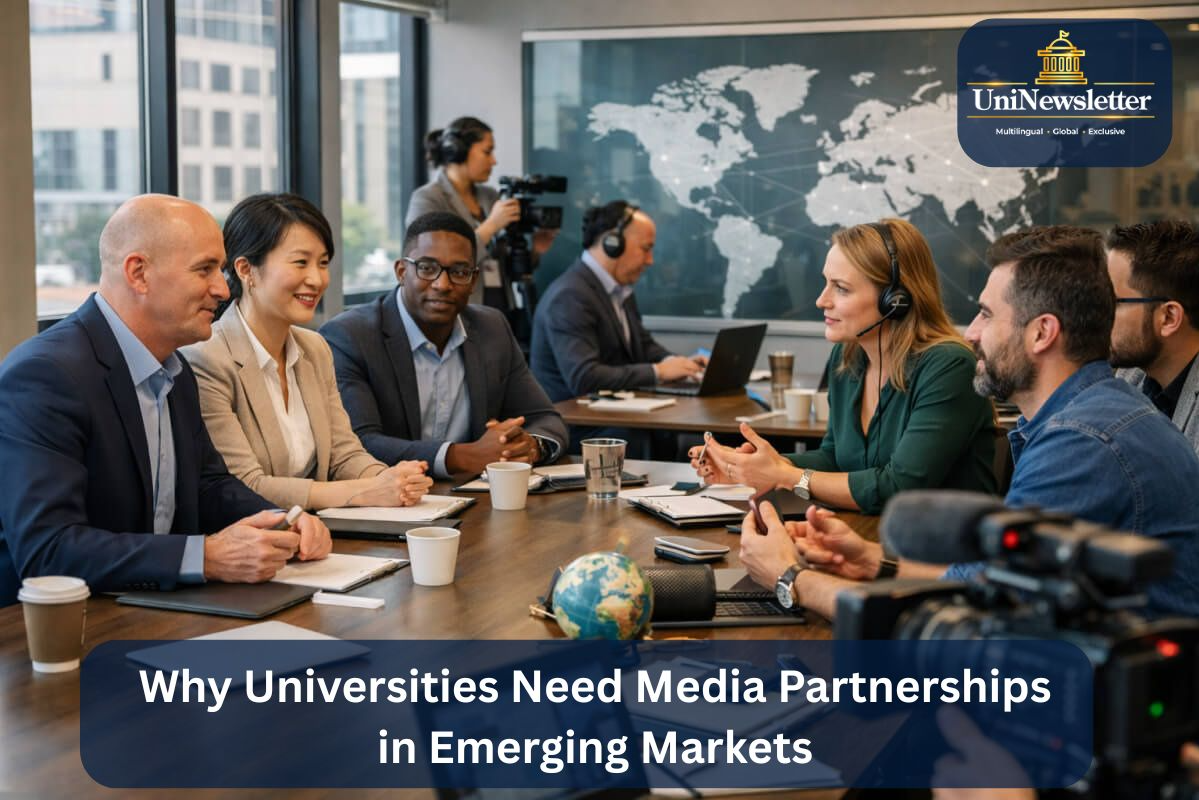
Simply put, media partnerships in higher education are strategic alliances between an institution and a media house
(like UniNewsletter or local news outlets). Unlike a standard "ad buy," these partnerships are about co-creating
value.
It’s the difference between a "sponsored post" and a featured expert interview. When your faculty’s research is
published in a local business journal, you aren't just "marketing", you are demonstrating competence. This is a core
part of any modern
global education marketing partnership . Research
from The
Chronicle of Higher Education suggests that deep editorial
collaborations are far more effective at building long-term institutional prestige than transactional advertising.
How Media Partnerships Strengthen University Brand Visibility
Brand visibility is a math problem. If you aren't seen, you don't exist. But in emerging markets, where you are
seen matters more than how often.
A strategic partnership puts your university in the "flow of information" where parents and students already spend
their time. Whether it’s an editorial piece in a major digital news portal or a specialized
university reputation boost through consistent press coverage, these touchpoints build a
familiar "omnipresence."
By the time a recruitment officer reaches out to a lead, that lead should already feel like they "know" your school
because they’ve seen your experts quoted in the news.
Media Partnerships and International Student Recruitment
How do these partnerships actually support international student recruitment in emerging markets? It comes down to
the "Validation Loop."
Awareness: A student sees an article about your university’s innovative engineering lab in a local tech
blog.
Trust: They see a follow-up interview with a successful alumnus from their own city.
Action: When they see your recruitment ad later that week, the "friction" to click and apply is gone.
The
Times Higher Education rankings show that
universities which succeed at localizing their stories become the most successful institutions for student
recruitment. Media partners help you tell that story in a way that resonates with local ambitions.
Digital Media Strategy for Universities in Emerging Markets
Digital habits in 2026 are highly fragmented. In many emerging markets, students don't check email; they check
WhatsApp, Telegram, or local social portals. A digital media strategy for universities must be "platform-native."
Strategic partnerships enable you to use existing digital systems that established media companies have developed.
Your message functions as more than a website link because it exists as a video and podcast episode and
mobile-optimized article which people share. Universities need to focus on creating
localized content that matches the digital usage habits of their local communities to achieve
success.
Strategic Partnerships for Long-Term Expansion
The university should establish a partnership if they want to achieve sustainable growth for their International
Higher Education program.
Strategic alliances provide a "halo effect." The alliances safeguard your brand during economic downturns while
preventing you from starting your recruitment process from zero in each recruitment period. Your
university will develop better recruitment
services through these partnerships because your brand will handle most of the work before your sales team begins
their tasks.
The study by
Deloitte on Higher Education University partnerships are the main factor that enables
universities to achieve sustainable international growth. The study shows that universities have abandoned their
previous "agent-only" models for their international expansion.
Measuring the Impact of Media Partnerships
How do you measure "trust"? You look at the downstream data:
Organic Search Volume: Are more people searching for your university name specifically?
Inquiry-to-Application Ratio: Higher-quality leads usually come from editorial sources rather than "cold"
ads.
Cost Per Enrollment: Does the overall cost of acquiring a student drop as your brand becomes more
"verified" in the market?
Data from the
British Council suggests that institutions with high
media visibility in target markets see a significant reduction in long-term recruitment costs.
Common Mistakes Universities Make in Emerging Markets
The "One-Size-Fits-All" Tone: Using the same brochure in Beijing as you do in Bogota.
Short-Term Thinking: Pulling out of a market if the first webinar doesn't result in 100 applications.
Ignoring Local Voices: Relying purely on central office staff who don't understand local trust signals.
Overselling: Focusing on "campus lifestyle" when the student is focused on "employability."
Conclusion
The period when universities operated as separate institutions has ended. Global education in 2026 will be
conducted through international partnerships. The universities that will succeed in emerging markets need to develop
partnerships with better organizations than their financial resources.
Your decision to collaborate with Higher Education media specialists goes beyond basic advertising work. Your
organization develops a presence which establishes trust through verification and comprehensive market penetration
in worldwide developing sectors. The time has arrived to establish a brand which students already trust instead of
pursuing potential customers through lead generation.

 26-05-2023
American University of Ras Al Khaimah
26-05-2023
American University of Ras Al Khaimah


 Featured Video