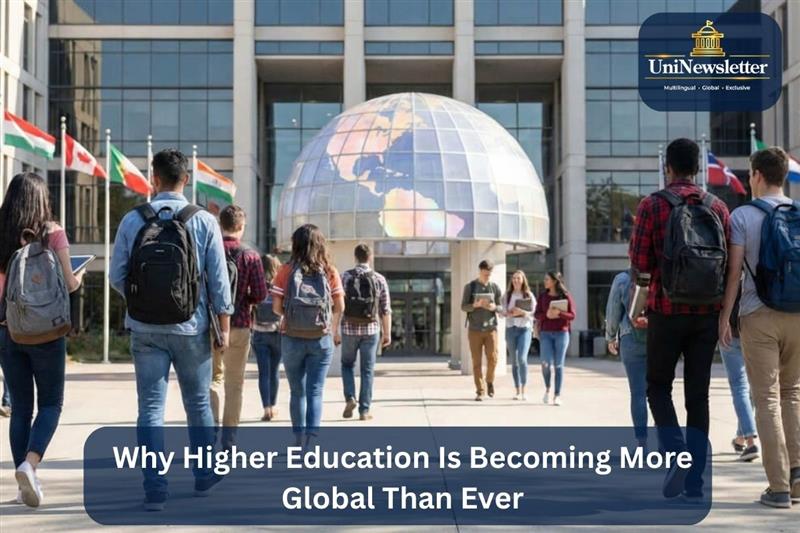
The traditional image of a university was once a static one: a set of stone buildings where local scholars taught
local students, preparing them for local careers. That era has ended. Today, a degree is less a local credential and
more a global passport. Whether you are a student in Mumbai looking at master's programs in Berlin, or a university
administrator in London seeking research partners in Singapore, the walls of the ivory tower have effectively been
dismantled by a shift toward a borderless academic world.
The extent of this change is hard to believe. The number of students attending schools outside their home country
has tripled in the last 20 years to over six million worldwide — and that number continues to grow rapidly. This
surge reflects more than just the physical movement of students across borders; it represents the full globalisation
of higher education. Universities around the world are now shaping nearly identical curricula, criteria, and
learning outcomes to educate students for a shared global future. At
UniNewsletter , we track and analyse these shifts to
better understand how international student mobility is reshaping recruitment strategies, learning models, and
institutional priorities worldwide.
What Is the Globalization of Higher Education?
To understand where we are going, we have to define what this "globalization" actually looks like. It is the
systemic integration of national education systems into a single, interconnected market. It involves the flow of
ideas, people, and capital across borders to create a global education system that values universal recognition of
qualifications.
While "internationalization" refers to the specific policies universities use to integrate global perspectives,
globalization is the broader force driving these changes. It is the economic and social reality that makes a
business degree from Sydney relevant to a tech firm in San Francisco.
Key Drivers Behind Global Higher Education Trends
The acceleration of international education growth isn't an accident. It is the result of three converging forces:
the labor market, government policy, and technology.
The War for Talent: Employers do not only seek to hire "local talent", but they are looking for "global
competencies". In the United Kingdom,
the British Council published a study indicating
that the majority of employers prefer candidates with international work experience, emphasising these candidates'
superior problem-solving skills and cultural adaptability.
Economic Strategies: In many countries, education is a major source of export income. Several countries,
including Australia and Canada, receive many billions of dollars as a gross domestic product (GDP) contribution
from the international education industry, which has encouraged governments to remove barriers to obtain visas for
the purpose of attracting their very best talent.
Digital Infrastructure: We have moved past the era where "online" meant "lower quality." As explored in our
deep dive into
how technology will redefine higher education in the next 5 years , the digital era has made
high-level research and degree programs accessible to those who cannot physically relocate.
Internationalization of Higher Education Institutions
Universities are no longer passive participants in this trend. The internationalization of higher education has
become a core strategic pillar for almost every top-tier institution. This isn't just about recruiting students to
fill seats; it’s about the "global classroom."
More universities are modifying their curriculum to be globally aligned. The historical study plan of 2024 is
significantly different from that of 1994 and now reflects a multicultural approach. In addition, the trends of
higher education globally indicate a significant growth in "joint degrees" where a student can spend their first two
years studying in France and their last two years studying in Japan, ultimately graduating with a degree from both
countries.
Rise of Cross-Border Higher Education Models
We are seeing a move away from the "hub and spoke" model where students always travel to a central western campus.
Instead, cross border higher education is taking the form of "Transnational Education" (TNE).
This includes branch campuses, where a New York university opens a full-service campus in Abu Dhabi, and "twinning"
programs.
ICEF Monitor shows that TNE (transnational education)
increased at a faster rate than traditional migration in many of the world's major markets. Therefore, it is now
possible for students to obtain a high-quality international degree without incurring the large financial burden
associated with studying abroad - in effect accelerating the process and providing increased access to the best in
academic brands for a wider range of students.
Global Access to Higher Education: A Question of Equity
As many of these emerging trends appear to indicate positive movements, one must still consider the question: Is
Global Access to Higher Education improving for all individuals?
For a long time, the global education market was an elite club. However, the rise of regional education hubs in
countries like Malaysia, China, and the UAE has lowered the barrier to entry. The ability for students who
previously could not afford to fly to London for English-medium education is now an option for students living in
more proximity to that institution, but the divide remains with respect to the digital divide; therefore, the
future of students to study internationally through digital means will be determined by speed
of internet access and stable power supply, neither of which are yet universally available.
Higher Education Global Mobility and Student Trends
For many years, international students have travelled primarily from East to West. However, today's trends
illustrate a much more nuanced approach to international student mobility.
Intra-Regional Mobility: More students from Africa will now consider South Africa or Egypt instead of
Europe when choosing where to study.
The "Stay Rate": Students are increasingly choosing destinations based on post-study work rights. Nations
that offer a clear path from graduation to employment are winning the "mobility war."
Ranking Obsession: The influence of lists like the QS World University Rankings cannot be overstated. As
we’ve noted in our analysis of
how global rankings influence international student decisions , a move up or down a list by
five spots can result in a gain or loss of millions in tuition revenue.
Benefits of a Global Education System
The primary benefit of higher education global mobility is the "brain circulation" it creates. When students move,
they don't just take their tuition money; they take their culture, their unique problem-solving approaches, and
their networks.
From a research perspective, the benefits are even clearer. Research published by the journal '
Nature ' has demonstrated that the papers produced by research
teams composed of different nationalities receive far more citations than do those published only by national
researchers. This fact suggests that in light of the current race to find solutions for the global crises of climate
change and pandemics, a truly globalised academic community is an essential condition for achieving success in the
above-mentioned areas.
Challenges of Globalizing Higher Education
Several factors are contributing to the growth of global opportunities for tertiary education for all.
Geopolitical factors: Trade wars and diplomatic disagreements often lead to entry restrictions or visa
cancellations. Therefore, thousands of students who have received a visa will be disappointed to not have an
assigned school and will have lost direction in an unfamiliar environment.
Standardization across Borders: Many believe that "global standards" actually mean "Western standards", and
therefore they fear that Indigenous knowledge and traditional forms of Academic expression will become extinct.
Brain Drain: While we aspire to achieve "brain circulation", we have numerous developing countries dealing
with "brain drain" which is defined as the exit of the best and brightest educated individuals to the West for
higher-earning jobs and they do not return.
The Future of Global Higher Education
As we look toward the future of global higher education, the focus will shift from "quantity" to "quality of
integration." We are moving toward a "Stackable" global degree. Imagine a future where a student takes a
foundational year via a MOOC (Massive Open Online Course) from Harvard, does their second year in person at a
university in Seoul, and completes their final credits through an internship in Berlin.
The
OECD estimates that by the year 2030, the number of individuals wishing to pursue a college
education will total 414 million individuals worldwide. We cannot meet this projected increase with bricks and
mortar facilities alone. The future is a hybrid, fluid, and highly personalized journey that ignores physical
borders in favor of intellectual ones.
Final Perspective
The world's problems, economies and communications are global. Because of this, more students are attending
colleges and universities outside their home countries and gaining exposure to different cultures. For today's
higher education international students,
universities are more than just places of
learning; they provide access to a global community.
It is no longer a question of whether higher educational institutions or students will go global but rather how
they will adapt to the reality of a world in which local options do not suffice. Globalization of the mind begins
with globalizing the classroom and this process is irreversible.

 26-05-2023
American University of Ras Al Khaimah
26-05-2023
American University of Ras Al Khaimah


 Featured Video