Did you remember when studying abroad was all about
university
rankings, party life, or buildings? They still do, yes, but the whole new series of concerns is now shaping the conversation. Nowadays, students and families are considering extreme weather events, air quality, and pandemics. The world is changing, and so is international student mobility
education. This is not a shift—it's a whole revolution towards proactive prioritization of safety, resilience, and proactive education. The reality is that a school's academic reputation will have to be equaled by its commitment to students' welfare in a rapidly changing world.
The Core Challenge: Climate & Environmental Risks
Climate change is no longer an issue at the periphery; it's an urgent and central issue that cuts across all aspects of a student's life. It's a threat that is making the sector change. Students now ask questions about a nation's environmental reputation and a university's policy agenda
because the climate impact on studying abroad is now a very tangible threat.
It's not an expert issue. Survey data in a
2024 QS International Student Survey
indicates that an astonishing 88% of potential students consider a university's commitment to sustainability to be "moderately," "very," or "extremely" important. It's not a fleeting trend—there is a new market imperative. The survey went even further by highlighting that almost half of all
students would prefer a sustainable university over one in the world's top 100. That's a devastating message: the market is green-led.
The environmental factors in study abroad can be witnessed in live disruptions. A 2025 UNESCO report highlights that schools have been closed in at least
75% of extreme weather events
affecting five million or more people over the past two decades. It is not a trivial inconvenience; it is an instant danger to learning continuity and student safety. To mention just one example, California and Australian bushfires in recent years have prompted campus evacuations and air
quality warnings. Likewise, severe heatwaves in Europe are forcing institutions to develop new operational habits, and intermittent flooding in certain Asian regions is causing commuting dislocation and delayed semesters.
These events are compelling institutions to re-model everything, starting from the campus infrastructure to the emergency response. "What if?" is no longer a question, but "when?"
The COVID-19 Turning Point: Lasting Health Vulnerabilities
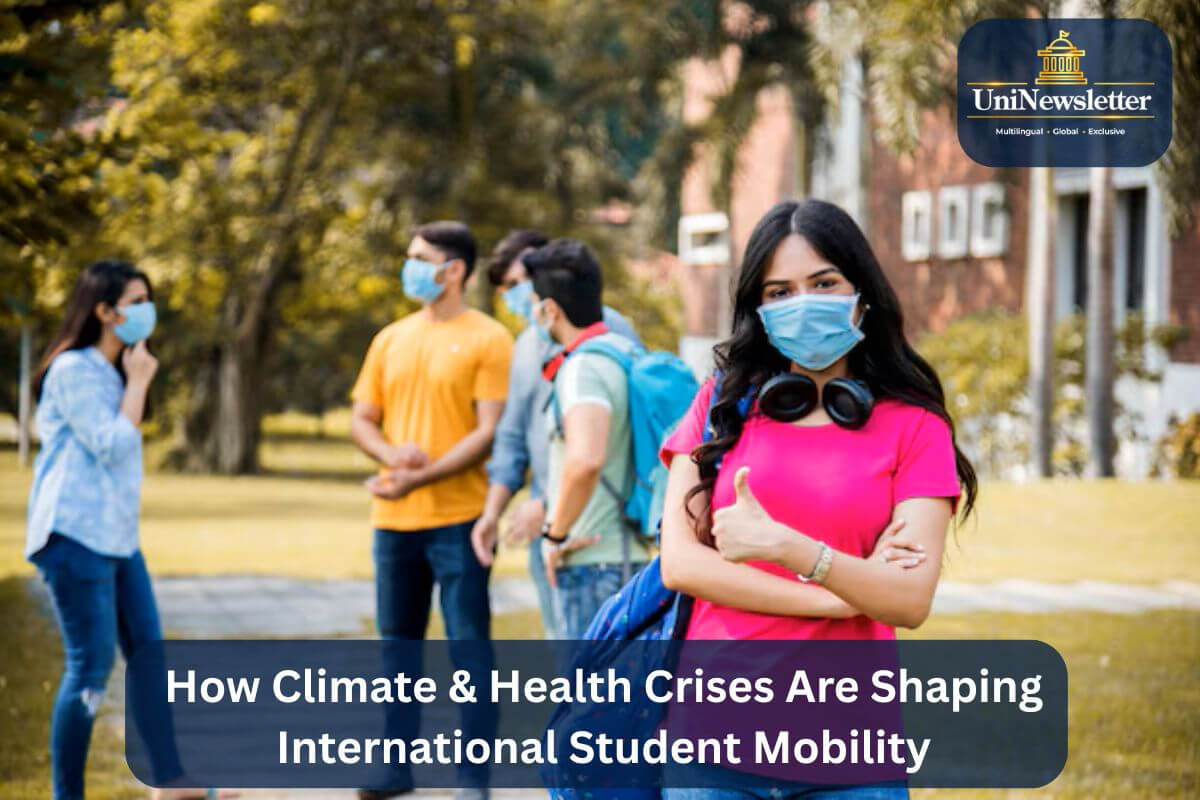
The COVID-19 pandemic revealed not only the weakness of our globalized world but also the bitter lesson of institutional incapacity. Abruptly closing borders and travel infrastructures created gigantic health crises in education, with students stranded and unprepared. What we learned from that
crisis is that crisis unpreparedness is a core business weakness.
The global crises educational impact can best be seen in the well-being of students. In 2020, a study published in the Frontiers in Psychiatry journal determined that
84.7% of foreign students
experienced great stress during the pandemic. In 2021, it was discovered that 49% of foreign students had depression, far higher than domestic student rates in many nations. Barring the figures, those crises left a profound sense of doubt and loneliness that neither parents nor students are
willing to revisit. They are raising questions about the fundamental nature of a university's health care services, the availability of mental health services, and the crisis communication policy overall. Bad communication of good services is a turn-off.
How Student Preferences Are Changing the Market
Not only are the students responding to these crises, but they are also propelling a shift in the market. The market is seeing a definitive move away from sites deemed to be high-risk and driving towards sites with the ability to prove their dedication to safety and sustainability. This has
resulted in the apparent increase in the popularity of nations such as those in Northern Europe and Canada, which are historically considered to be more stable and ecologically responsible. Their highly regulated and effective publicly funded healthcare systems and strict sustainability
policies are now a competitive necessity.
For enhanced comprehension of the forces at work, refer to our article on how geopolitics is also shaping international student decision-making since such global forces commonly overlap.
How geopolitics is influencing study abroad destinations
This strategic shift is at the center of the new landscape of climate change and higher education. It's a shift that is appropriate for countries that have a history of vision and social awareness. Students want to be certain in their decision, knowing their host country and host institution
have an agenda for the unforeseen.
The Rise of Virtual Mobility & Tech-Enabled Solutions
While physical mobility continues to be challenged by both emerging and historical forces, there is a concurrent trend and no less significant: the increase in virtual and hybrid patterns of learning. The pandemic demonstrated that technology can overcome physical distance, but the message is
more profound. Universities are now employing digital platforms not as an aside but as part of their long-term strategic plan for resilience.
Platforms that allow smooth remote learning, virtual campus visits, and online orientation are the new norm. This offers students a helpful "Plan B" in the event of a natural disaster or health emergency at a destination. It also facilitates a new kind of "virtual mobility" where students can
interact with a foreign institution and culture without the actual travel, pushing education towards more democratization and fewer carbon emissions due to international student mobility. This technology innovation affects ground support, too. Mobile apps and AI platforms are being created to
provide real-time data on health hazards, air quality, or community crises. These technologies provide students with the data they require such that they make informed decisions and enhance security even further.
The Institutional Imperative: Building a Resilient Future
In this new world, governments and universities need to innovate or be left behind. The playbook of always playing by reputation is no longer valid. The leaders who will thrive are those who break through more traditional recruiting and strive to create authentic resilience.
This includes putting more emphasis on:
Climate Resilience:
Campuses must establish formal policies for the protection of their land against bad weather. It is an investment in future reputation and security.
Student Welfare:
Providing comprehensive health coverage, accessible mental health care, and open crisis management policies is no longer a nicety but a competitiveness necessity. Health risks for international students are in our minds, and schools have to come up with open, reassuring solutions.
Priority Value of Sustainability:
Institutions will need to take extremely seriously their sustainability mission, ranging from the transition to alternative energy sources to the inclusion of climate literacy in the curriculum. It addresses values of students and induces an orientation with a shared future.
The new reality is that a university's brand is now tied to its response to global crises. Its safety record for its students and commitment to a sustainable future will be the benchmark of its success in the days to come. For an overall guide to making the best choice, be sure to look at our
step-by-step resource.
Choosing the right university abroad: A step-by-step guide
In brief, the climate impact on studying abroad and the long-term implications of international health emergencies are not marginal issues. They are decisive issues for every global education choice made today. At
UniNewsletter , we believe that colleges and universities that will succeed are those that make resilience, security, and sustainability their core values, demonstrating to students that they are investing in not only their future but in a secure, responsible future.

 26-05-2023
American University of Ras Al Khaimah
26-05-2023
American University of Ras Al Khaimah


 Featured Video