For decades, choosing a world-class university basically meant you were choosing between North America and Europe. But by 2026 that is no longer the full picture, and the Gulf region is one of main reasons why, honestly.older, dependable strongholds in higher education are easing out a bit as the Gulf ramps up its presence , and honestly figuring out what’s fueling this change matters if you are a student trying to decide where you should go next.
Overview of Gulf vs Western Universities Western universities, especially in the US, UK, Canada, and Australia have, for generations now, basically been the default map of global higher education. Their research output plus alumni networks and industry reach, plus that overall institutional prestige, makes them the obvious pick for many internationally mobile students who are ready to put money into a degree somewhere else.
By comparison, Gulf universities, mainly in the UAE, Saudi Arabia, and Qatar, are a newer storyline. A lot of the serious investment in higher education across the region started in the early 2000s, so even the oldest of the region’s leading institutions are only about, two decades, give or take, into their current build. Still, the momentum has been pretty extraordinary. In the 2026 QS World University Rankings there are 107 universities from the Arab region, 25 more than the previous year. And 42% of the ranked Arab institutions moved upward. The UAE in particular managed to place nine universities in the top 25 of the QS Arab Rankings, and Khalifa University even moved into the global top 200, which is kind of a big deal, in this context.
67th KFUPM's 2026 global QS rank, first Arab university in the top 100 107 Arab universities in QS World Rankings 2026, up 25 from the prior year 42% Of ranked Arab universities improved their global position in 2026 Why Gulf Universities Are Gaining Popularity The growth in interest in middle east universities for international students is not driven by rankings alone. Three factors have combined to make the Gulf genuinely attractive to a new generation of globally mobile students.
First, government investment at scale. On top of that, Saudi Arabia’s Vision 2030 has pushed billions into research in universities, hiring faculty, and building campus infrastructure, with a stated ambition to have five Saudi universities in the global top 200 by 2030. The UAE’s Higher Education Strategy 2030 links how institutions perform with national competitiveness too. This is not just quiet support, it’s hands-on, funded properly, and clearly time-bound.
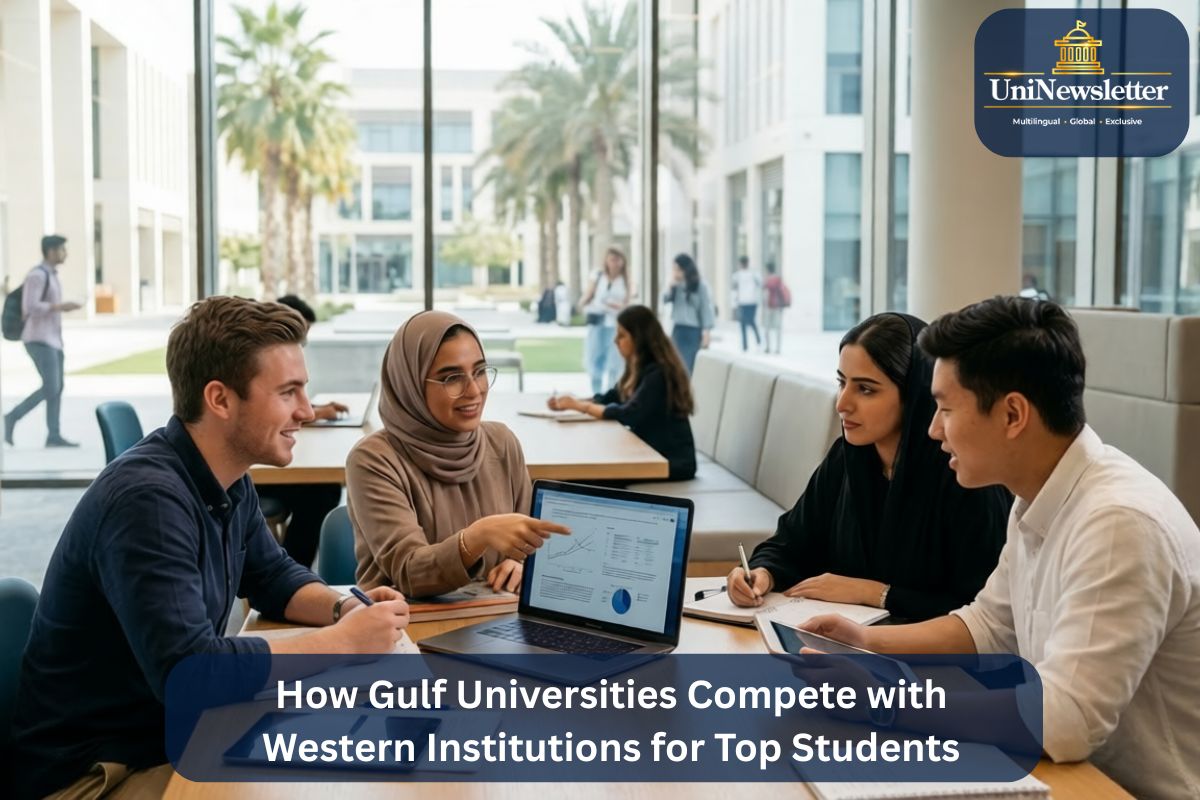
Second, the branch campus model. The Gulf states have hosted branch campuses of NYU, the Sorbonne, Manchester, Middlesex, and dozens of other globally recognised Western institutions. Students can earn a degree from a brand-name Western university in a Gulf location, gaining both the credential and the regional career proximity. This has blurred the traditional distinction between studying in the Gulf and studying in the West.
Third, visa and policy stability. At a time when the US, UK, Canada, and Australia have all introduced significant restrictions on international student visas, the UAE and Qatar kept things more welcoming, and yes, more straightforward for arrival. Universities entering new recruitment markets face the challenge of adapting to shifting policy environments, and the Gulf's relative stability is a real differentiator in the current climate.
How Gulf Universities Attract International Students The recruitment strategies of Gulf universities have become, pretty quickly, more sophisticated in a way that is hard to ignore. They now run generous scholarship programmes that are aimed at high achieving students from South Asia, Southeast Asia, and also Africa, which has sort of opened the door for learners who really could not foot the bill for a Western education, even if they wanted to. And honestly, how these universities track and build global reputation , plus their online presence, matters a lot here. Because Gulf institutions have invested heavily in international marketing, they’ve built multilingual digital presence, and they’ve done targeted outreach in growth markets too.
Comparison: Gulf vs Western Universities
Factor
Gulf Universities
Western Universities
Tuition & Scholarships
Often subsidised or scholarship-funded; lower cost for many international students
High tuition fees, especially in US and UK; scholarships competitive
Rankings Trajectory
Rapidly improving, significant year-on-year gains in 2025 and 2026
Established positions; slower movement at the top
Research Output
Growing fast but still behind in volume and citation impact
Deep legacy research culture; highest global citation impact
Employer Networks
Strong regional industry ties, especially in energy, finance, logistics
Broader global alumni networks across more sectors
Campus Life & Culture
Cosmopolitan environment but with social restrictions in some countries
More diverse social and extracurricular experience
Visa & Policy Access
Stable, welcoming visa environment for most nationalities
Increasing restrictions in major destination countries
Language of Instruction
Predominantly English at international institutions
English dominant in US, UK, Australia, Canada
Study in UAE vs USA Universities For students specifically comparing studying in the UAE vs USA universities, the choice usually comes down to cost, career location reach, and the post-study working rights. In the USA, universities that are more research oriented tend to give better access to global alumni circles, plus more hands-on research options. There’s also the OPT route, which lets international graduates actually work in the US for up to three years after finishing their degree. The prestige of a US degree is also still the strongest of any single country globally.UAE is also emerging as a top work destination for international students , especially in finance, technology, logistics, and hospitality, areas where Dubai and Abu Dhabi’s growth pace gives employment prospects that stack up pretty well with many Western cities.
Role of Rankings and Reputation Rankings matter to international students, but not always in the way institutions assume. Times Higher Education's 2026 Arab University Rankings cover 268 institutions, and their growing prominence in global ranking tables is steadily shifting employer perception of Gulf credentials in international markets. The metric where Gulf universities score highest, employer reputation, is arguably the most important one for students focused on career outcomes rather than research prestige.
Most apparent, of course, is the research reputation and impact gap. The US News 2025-2026 Best Global Universities rankings of the top 2250 institutions in the world by research and reputation rank the top layer as still being Western research universities. For students who seek academic and research-based futures, it is Yes noteworthy.
Career Opportunities After Studying in the Gulf One of the Gulf strongest arguments for international students isn’t the degree itself, more like what comes right after it. Dubai, Riyadh, Doha and Abu Dhabi are among the world's most rapidly growing commercial cities. Those who graduate from Gulf universities and remain in the Gulf public or private job markets will face far less competition from local students than in the saturated Western cities they've left behind, as well as come into contact with the world's largest infrastructure, energy and finance schemes.
Challenges Gulf Universities Face An honest assessment requires acknowledging where the challenges remain real. Research legacy cannot be manufactured quickly, the deepest Western universities have accumulated decades of Nobel laureates, landmark publications, and research infrastructure that shapes industries globally. Matching that at scale requires sustained investment over a generation, not a decade.
Academic freedom is also a consideration for some students and faculty. Gulf universities operate within national legal and social frameworks that impose constraints that are largely absent in Western contexts. This affects the range of subjects that can be studied and researched freely, a factor that matters more in some disciplines than others.
Finally, global graduate mobility from Gulf credentials is still developing. A degree from KFUPM or Khalifa University is well-understood in the Gulf and increasingly recognised in certain sectors globally, but does not yet carry the universal employer recognition of a degree from a top Western institution in every market.
Future of Global Higher Education Competition The trajectory is clear. QS notes that only nine countries globally added five or more universities to the rankings this year, and three of them are in the Arab region. As global student mobility is projected to reach nine million by 2030, the Gulf's expanded capacity is absorbing a share of that growth that would otherwise have flowed predominantly to Western destinations.
The future is likely not Gulf replacing West, but rather a genuinely multipolar higher education landscape where students choose based on a more sophisticated calculation, cost, career geography, employer networks, visa accessibility, and lifestyle, rather than simply defaulting to the traditional prestige hierarchy. The range of quality universities available globally has expanded meaningfully, and that expansion benefits students most of all.
Conclusion Gulf universities are not yet the global equivalents of institutions like University of Oxford or Massachusetts Institute of Technology, and most would not claim to be. But they are no longer viewed as a distant second choice for internationally mobile students from the region and beyond. At UniNewsletter , we have seen growing interest in Gulf-based higher education as students increasingly look for destinations that combine quality education, career opportunities, and long-term stability. The combination of rapidly improving global rankings, government-backed investment, international branch campuses, strong employer connections, competitive scholarships, and a welcoming visa environment has made the Gulf a credible and increasingly attractive destination for higher education international students who now have more choices than ever before and are making decisions accordingly.

 26-05-2023
American University of Ras Al Khaimah
26-05-2023
American University of Ras Al Khaimah


 Featured Video