Imagine this:
a prospective student who visits a university website at 11pm can receive immediate answers to three questions about the application deadline, scholarship eligibility, and English language requirements. The system provides instant answers to all questions. The system provides answers without
forcing users to wait until Monday morning or to wait three days for email responses.
That's not a future scenario. That's what AI chatbots in university admissions are doing right now, at institutions around the world.
The admissions landscape has experienced a complete transformation throughout its current state. Application volumes are rising, student expectations have changed, and the competition for talent, particularly international students, has never been more intense. Universities that respond
slowly, inconsistently, or not at all lose prospective students to institutions that have mastered the art of being present and responding to student needs throughout their entire decision-making process. At
UniNewsletter
, we observe that institutions succeeding in today’s environment are those that prioritise timely engagement, clear communication, and a student-first approach across all touchpoints.
According to research,
69% of consumers prefer chatbots for quick communication
with brands, and prospective students are no different. They expect the same instant, digital-first experience from a university that they get from every other service in their lives.
What Are AI Chatbots in University Admissions?
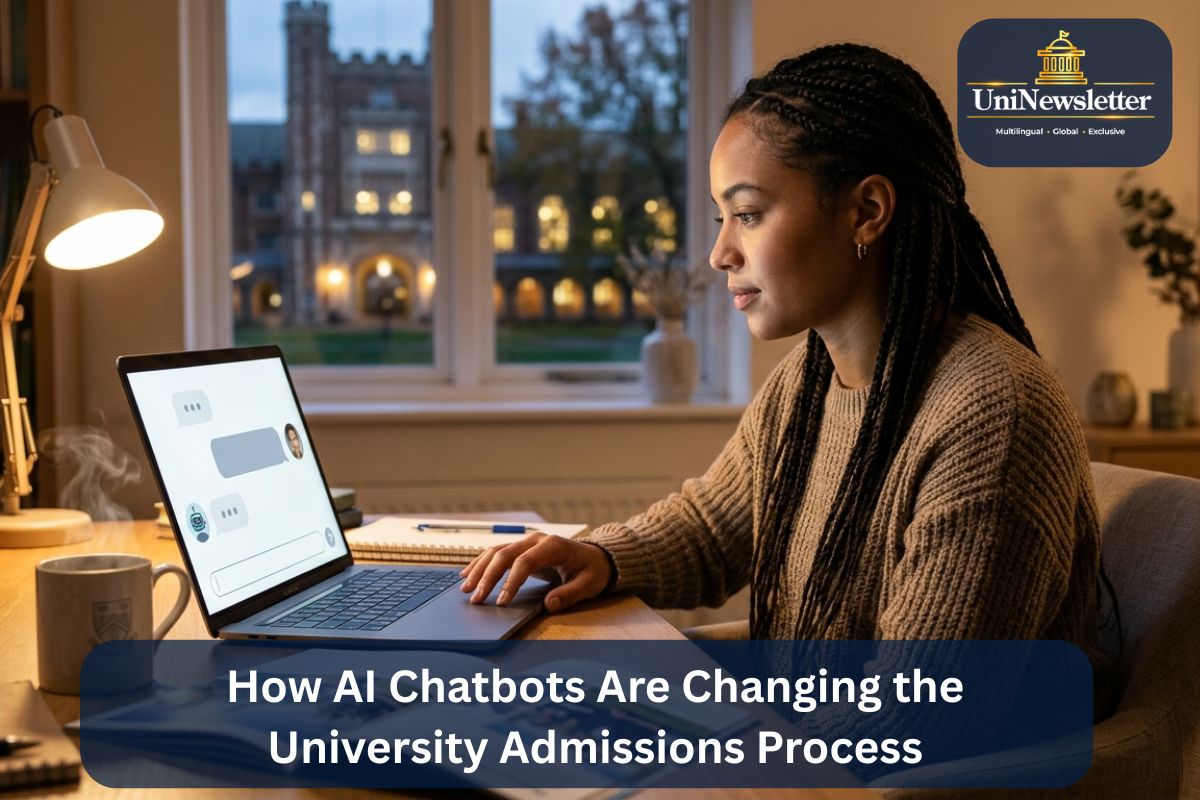
At their core, the AI chatbots in this system operate as interactive systems which utilize natural language processing technology that
OpenAI
Google and Microsoft use in their products to understand student inquiries and provide accurate information during real-time sessions.
The university admissions process requires staff to answer common questions about programs and tuition costs and admission standards. The system guides students through the application process by sending them document reminders while they track their application progress and book time with
admissions personnel. The organization needs to perform these tasks at the same time for many students who speak different languages while they handle their requests without requiring them to wait in line.
What it isn't, and this is worth being clear about, is a replacement for human admissions officers. The best AI systems enable organizations to process their high-volume tasks while handling their basic operations which allows staff members to focus on their work that needs human
decision-making abilities and relationship-building skills.
Why Universities Are Adopting AI in Admissions
The honest answer is that the pressure to adopt has become hard to ignore.
Artificial intelligence in higher education admissions is growing not because it's fashionable but because the operational math has changed. A mid-sized university might receive tens of thousands of inquiries during peak admissions periods, far more than any admissions team can handle
personally with the speed students now expect.
A
report by Drift
found that the average response time for a web inquiry at a business is 42 hours. For a prospective student comparing five universities, that's enough time to have already committed to one of the others.
Automation in higher education admissions addresses this directly. Universities adopting AI-powered systems aren't cutting corners on the student experience, they're trying to meet students where they are, on the timeline students actually operate on.
The other factor which drives the situation onward exists because of worldwide competition. The universities of the United Kingdom, Australia, Canada and the United States all compete for the same group of international students. Institutions which provide quicker responses and better
communication and easier application processes to users will succeed in the competition despite their academic offerings.
Key Benefits of AI Chatbots for Student Recruitment
24/7 instant support
is the most obvious benefit but still worth stating clearly. Admissions inquiries don't arrive between 9am and 5pm. Students research universities in the evenings, on weekends, and across time zones that have nothing to do with the institution's working hours. A chatbot that's always
available doesn't just improve response times, it removes a genuine barrier to engagement.
Personalised student interaction
goes beyond answering generic questions. The current AI-based admissions systems track prospective student activities while providing personalized responses based on their declared interests and academic qualifications and suggesting suitable academic programs. The system required for
personalized services at large scale operations did not exist before this period.
Improved lead conversion
follows naturally. According to
research by Intercom
, businesses that respond to leads within five minutes are 100 times more likely to convert them than those who wait 30 minutes. The same principle applies in university admissions. Faster, more relevant engagement keeps prospective students in the funnel.
The process of achieving cost and time efficiency develops through its ongoing progression. A
study by IBM
found that chatbots can handle up to 80% of routine customer inquiries which decreases the administrative duties that admissions teams must perform. Staff members who no longer need to answer the same 20 questions multiple times can dedicate their time to handling challenging cases and
conducting scholarship interviews and building relationships with potential applicants who show genuine interest.
How AI Improves the Admissions Process - Stage by Stage
The value of AI in the college admissions process isn't limited to a single touchpoint. It runs across the entire student journey.
Pre-application
, chatbots answer course queries, explain entry requirements, assist with programme comparison, and help students understand whether they're eligible, before they've invested time in a formal application. This alone reduces the volume of incomplete or mismatched applications that admissions
teams have to process.
During the application stage
, the application process uses AI to assist students with their form needs while identifying missing documents and delivering deadline alerts and material receipt confirmations. The step-by-step support system helps students who apply in a second language or through an unfamiliar system
because it significantly decreases their chances of dropping out.
Post-application
, the communication gap which frequently creates difficulties for applicants will be addressed through status updates and onboarding materials and responses to upcoming process queries. Students who feel informed and supported during this period are more likely to accept an offer when it
arrives.
How students are choosing universities in the digital age
has evolved to the point where the digital experience of interacting with a university is itself part of how students evaluate whether they want to study there.
The Role of Chatbots in International Student Recruitment
AI establishes its transformative impact on higher education institutions which compete in the worldwide academic marketplace.
International students encounter multiple hurdles which include they experience difficulty with phone and email interactions because of time zone variations and they struggle to understand complex documents due to language limitations and they face challenges when trying to learn about unknown
systems from outside the country.
The international student chatbot system handles three inquiry types at once. The modern AI systems now treat multilingual capacity as a standard feature which enables students to get precise information through their native languages. The system provides continuous service which eliminates
any obstacles created by different time zones. The system enables users to obtain answers about visa documentation and language requirements and application deadlines from a single platform which helps users handle their complex tasks more easily.
The
QS International Student Survey
shows that international students choose their final institution based on the quality of information which they receive during the inquiry stage. A well-performing chatbot for this stage takes direct control over recruitment results because it improves operational efficiency.
Students need to begin their
university selection process for studying abroad
before they submit their applications, and universities which help students during their research phase will achieve success when it becomes important.
AI-Powered Admissions Systems and Automation Tools
The admissions automation tools used by universities extend their functions through CRM systems which monitor student interactions across different communication channels and their system uses predictive analytics to identify students who will likely submit applications and complete their
enrollment process while their lead scoring system enables admissions teams to establish outreach priorities.
The admissions process at universities experiences digital transformation because it shifts from being a reactive administrative function to becoming an active recruitment process that uses data for its operations. The institutions which adopt AI for student behavior analysis and intent
prediction and mass communication customization build a structural advantage against those who continue using email and spreadsheets for their operations.
Challenges Worth Being Honest About
AI in admissions isn't without its complications, and glossing over them doesn't help anyone making real implementation decisions.
The lack of human touch
is a genuine concern. Some prospective students, particularly those facing complex personal circumstances or making high-stakes decisions, need a human conversation. An AI system that handles everything and routes nothing will frustrate these students and potentially lose them.
Data privacy
is a serious consideration, particularly for institutions recruiting internationally across different regulatory frameworks.
GDPR in Europe
,
FERPA in the US
, and equivalent legislation elsewhere all have implications for how student data is handled in AI systems.
Accuracy and reliability
matter enormously in an admissions context. A chatbot that gives a student incorrect information about entry requirements or application deadlines can cause real harm, to the student and to the institution's reputation.
Best Practices for Implementation
Universities getting this right tend to share a few common approaches.
They begin their work by establishing specific goals which require them to identify the admission process elements they want to enhance and the standards they will use to measure success before they select their technological tools.
The company dedicates resources to training its chatbot system with precise data which receives regular updates because AI systems depend on their training data for operational performance.
The system employs artificial intelligence together with human escalation routes which allow students to contact staff members whenever required instead of forcing them to stay in automated systems.
The organization approaches implementation as an active process which continues to operate after initial setup because they track system performance while detecting student conversation drop-off points and they use that information to optimize their answer development process.
Where This Is All Heading
The next five years of technological advancement in higher education
will bring three main changes to universities because they will create more personalized learning experiences for students while they automate administrative processes and use artificial intelligence throughout student admissions and academic development.
The future will bring voice-based conversational artificial intelligence together with hyper-personalised application processes and predictive enrolment modelling systems. The institutions which develop artificial intelligence capabilities for their admissions processes will achieve faster
adaptation to upcoming changes than institutions which need to establish their systems from scratch.
According to
HolonIQ
, global EdTech investment reached $20 billion in recent years, with AI-powered student engagement tools among the fastest-growing categories. The direction of travel is clear.
The Bottom Line
AI chatbots aren't replacing the human side of university admissions. They're handling the volume, the routine, and the around-the-clock availability that human teams simply can't sustain, so that human teams can focus on the work that actually requires them.
For universities serious about competing for the best students globally, how AI improves student admissions isn't an abstract question. It's a practical one with measurable answers, in response times, conversion rates, staff efficiency, and ultimately, enrolment numbers.
Explore how
UniNewsletter supports universities
in connecting with prospective students through smarter digital engagement strategies.

 26-05-2023
American University of Ras Al Khaimah
26-05-2023
American University of Ras Al Khaimah


 Featured Video