"Where there's a will, there's a way," or so the saying goes. But does that actually hold up when the will requires
forty thousand dollars a year and the way involves an admissions committee that rejected ninety percent of
scholarship applicants last cycle? Here's the honest question so many students quietly Google at 2 AM: can
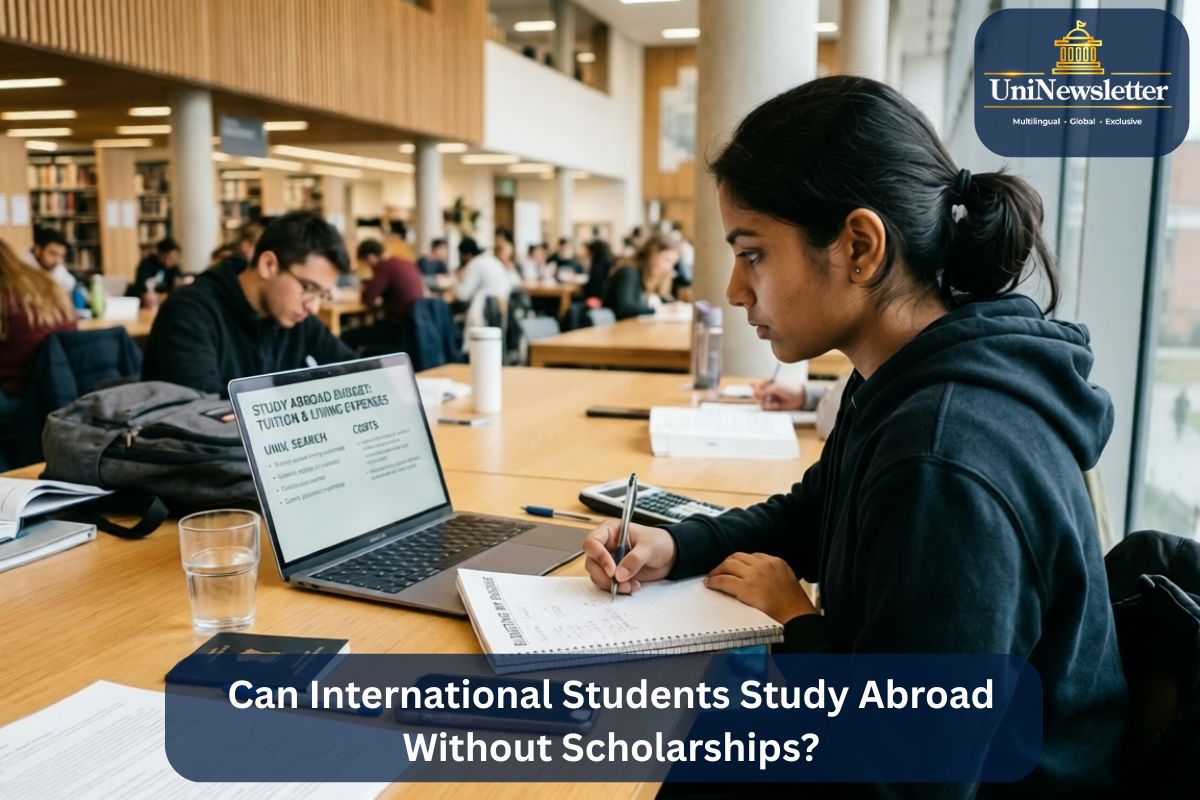
international students study without scholarships, or is that just something people say to be encouraging?
The real answer is yes—and it's far more common than many people realize. Every year, thousands of students
successfully study abroad without receiving a scholarship. Self-funding, family support, education loans, part-time
work, or a combination of these options are how most international students finance their education. This isn't a
workaround or a second-best option; it's simply the reality of how international education works. Scholarships have
always been an opportunity for some, not a requirement for everyone. At UniNewsletter , we help students explore
realistic study abroad pathways by providing practical guidance on funding options, budgeting, and planning for
overseas education. In this guide, we'll break down exactly how studying abroad without a scholarship works—country
by country, and cost by cost.
Is It Possible to Study Abroad Without Scholarships?
Self-funded education is not something you go for only after exhausting other options, it is the common route for
most international students since scholarships that cover both tuition and living expenses are in fact very rare and
are mainly reserved for a small group of outstanding applicants. The rest of the international student body funds
their education either by saving up, getting contributions from the family, or taking loans as well as doing
part-time work, often some combination of all of the four.
Global student mobility numbers back this up. Millions of students cross borders for higher education each year, and
scholarship databases simply don't have the capacity to fund anywhere near that volume. Alternative funding methods
aren't the exception, they're the norm, which means realistic financial planning matters far more than chasing a
scholarship that may never materialize.
Why Many International Students Study Without Scholarships
A few structural reasons explain why self-funding is so common, and none of them reflect poorly on the student:
Limited scholarship availability: Most scholarships cover a small fraction of applicants, not the majorityCompetitive selection: Merit-based scholarships often require near-perfect academic records, which simply isn't
realistic for most applicantsPartial scholarship programs: Many awards cover only a portion of tuition, leaving the rest to be self-funded anyway
Family-funded education: For a large share of international students, family savings were always the primary plan,
scholarships were never part of the equation to begin withIf scholarships are still part of your plan alongside self-funding, our piece on the role of scholarships in attracting international students is worth reading to understand where they genuinely make a difference and where
they don't.
Different Ways to Finance Study Abroad Without Scholarships
Self-funded international students typically draw from more than one source, rarely just one:
Personal Savings: The most straightforward option, though it requires years of planning ahead of the actual move.Family Support: Still the single largest funding source globally for international education, often combined with
other methods rather than covering everything alone.Education Loans: Covered in detail below, this is the most common gap-filler when savings and family support don't
cover the full cost.Employer Sponsorship: Less common, but genuinely available for students already working who are pursuing part-time or
executive programs abroad.Installment Payment Plans: A growing number of universities now offer semester-by-semester payment plans instead of
requiring the full year upfront, which eases the initial cash burden considerably.Education Loans for International Students
How to finance study abroad without scholarships almost always leads back to this question sooner or later. Education
loans fill the gap between what a family can save and what the actual cost of attendance demands, and the loan
landscape looks different depending on where you're borrowing from.
In the US, federal loans generally aren't available to international students, so most turn to private lenders. Rates
currently range broadly across the market, some lenders advertise fixed APRs starting under 5% for well-qualified
applicants with a US-based cosigner, while others without a cosigner requirement price loans considerably higher,
often into double digits. Americans studying abroad have it slightly easier, since federal loans can often be used
at approved foreign institutions listed under the Federal School Code system through studentaid.gov.
Indian students borrowing for overseas education typically see rates in a similar broad range, often collateral-free
up to a certain loan amount and requiring collateral above it. A useful, genuinely neutral resource here is the
Vidyalakshmi portal , a government-backed platform that lets students compare loan offers from multiple banks in one
place rather than approaching each lender separately.
A few things matter regardless of where you borrow from:
Loan repayment: Understand whether repayment starts immediately, after a grace period, or only after graduation, this
single detail changes your monthly cash flow calculation significantlyInterest considerations: A one or two percentage point difference in rate compounds into a genuinely large amount
over a long repayment term, so it's worth comparing more than one lender before signing anythingLoan eligibility: Cosigner requirements, credit history, and destination country all affect what you actually qualify
for, and a lender that works well for a friend studying in Canada may offer completely different terms for the UK or
GermanyFinancial planning: Borrow only what you need, not the maximum you're approved for, since interest accrues on the
full amount regardless of whether you spend it, and unused loan funds sitting in an account are still costing you
money every monthAffordable Countries for Self-Funded Students
Some destinations are simply built for a tighter budget, without meaningfully compromising on degree quality or
recognition.
Germany: There are very few or no tuition fees at public institutions in Germany for overseas students as the cost
normally consists of a small administrative fee per semester. Living expenses are expected to vary from around 700
euro to 1000 Euro per month according to the city, and students are allowed to work 140 full working days or 280
half working days per year. DAAD , the official German educational exchange organization, is probably the most
reliable and recent source of information about fees and scholarships offered by German public universities.
Poland: Tuition at public universities is genuinely low, often just a few thousand euros a year, with living costs
well below Western European levels.
Malaysia: Tuition and the cost of living are both very cheap compared to the rest of the world. Students often need
only around $400 to $600 a month for their entire expenses including rent. EMGS (The official Malaysian authority for international education) , the government's official entity dealing with foreign affairs for students
education-wise, regularly gives students with the latest information on visas, living expenses and other costs.
Ireland: Not the cheapest option, but strong in tech, pharmaceuticals, and data science, with solid post-study work
rights that offset the higher upfront cost. Official guidance is available through Education in Ireland, the
government body overseeing international student information.
UAE: A rising hub with tuition and living costs generally much lower than in the US, UK, or Australia, plus the bonus
of local currency linked to USD which eliminates the exchange rate risk from the budgeting.
Canada: Pricier than Germany or Poland, but consistently chosen for its post-study work permit options, which can
offset the higher upfront tuition over the medium term.
Can International Students Work While Studying?
Employment part-time is one of the best ways for self-funded students to augment their pocket money which they very
rarely use. International students are generally allowed in different countries to work part-time on campus up to
somewhere between 15 to 20 hours a week with an allowance given for full-time work over vacation periods or other
periods defined as breaks officially.
Job part-time: The rules vary quite a bit from one country to another and also based on the kind of visa you have.
Always double check the actual limit before taking such a stepWorking too much: Doing a job that is beyond the approved number of hours can mean losing our visa, so it is not a
wise thing to risk even if you are short on money during a monthDoing internships: A lot of courses offer internships as a part of the academic programme, which generally are
counted in a different way compared to the casual part-time work under most visa regulationsWork-study programs: Some colleges have a system where their students can work on campus in a limited manner for the
duration of the study visa. Usually, they are easier for foreigners to gain access to compared with the other
part-time jobs that are located in the city.Rules differ enough by country that it's worth checking specifics before you commit to a destination. Our breakdown
of part-time work rules for international students by country covers exactly this in more depth.
How to Reduce Study Abroad Costs
A handful of practical choices add up to meaningful savings over an academic year:
Choose a smaller or secondary city over the capital, rent alone can differ by 30-40% Share accommodation instead of renting solo, splitting rent and utilities several ways Use student discounts aggressively, transport, software, entertainment, most of it adds up Request free education or partial discounts of your fees, many educational institutions give them even with no formal
scholarship. Buy used textbooks or rent them instead of buying new every semester Budget monthly expenses in detail rather than estimating a rough annual figure Financial Planning Tips for Self-Funded Students
Create a study budget broken down by category, not a single lump annual figure Build an emergency fund covering at least one to two months of expenses Track spending monthly, not just at tax time or when a bill surprises you Consider exchange rates, since currency movement can quietly shift your real budget even when nothing else changes
Plan tuition payments around your income or loan disbursement schedule, not the other way around Common Mistakes Students Make
Assuming scholarships are mandatory to study abroad, when most students never receive one at all Underestimating living costs, particularly in the first month when setup expenses pile up Borrowing without a clear repayment plan, taking the maximum approved amount instead of the actual need Ignoring part-time work opportunities that could meaningfully offset monthly costs Choosing expensive destinations unnecessarily, when a comparable degree exists somewhere considerably cheaper Real Cost Comparison by Country
Country Average Annual Tuition Monthly Living Costs
Work Opportunities
Germany
Free to low (semester fee only) at public universities
€700-1,000
Up to 140 full days/year
Poland
€2,000-4,000
$500-900
Part-time allowed, 20 hrs/week typical
Malaysia
$3,000-8,000
$400-60
Limited on-campus work generally
Ireland
$12,000-25,000
$1,000-1,600
20 hrs/week during term
UAE
$8,000-20,000
$800-1,500
Limited, visa-dependent
Canada
$15,000-30,000
$1,000-1,800
20 hrs/week during term
Numbers given above are approximate ones for 2026 they fluctuate a lot given city and curriculum. That means get the current ones verified to you through an official contact at your future educational facility.
Frequently Asked Questions Can I study abroad without a scholarship?
The majority of international students actually have a multifaceted financing plan - they cover part of their costs through saved up money, family help, loans and part-time work.
How much money do I need to study abroad?
It varies totally as the country and city, from under 10,000 USD a year in countries like Poland or Malaysia to 50,000 USD or above in large US/UK cities.
Which countries are affordable for international students?
Countries like Germany, Poland, Malaysia and overall, the UAE, are some of the places that offer, alongside with living, the least tuition fees of the most popular study locations.
Can student loans cover overseas education?
Yes, both private lenders and, in some cases, government-backed loan programs specifically cover tuition and living costs for study abroad.
Can part-time jobs pay living expenses?
They can meaningfully offset costs, though rarely cover everything alone, most students treat part-time income as a supplement rather than a primary funding source.
Is studying abroad worth the investment?
Students are often the ones but obviously the career paths taken and the countries where you will be studying will largely decide. In our comprehensive article on whether it's worth studying abroad we list the real outcomes to weigh before you make a decision.
Conclusion Going abroad to study without a scholarship is not a settlement, it is just another, more common, route. Through budget-friendly host countries, campus jobs, student credit, money management, and such, a scholarship is no more a must but a plus that you can only do in very particular circumstances, should the miracle of being awarded it happen. Success stories of students coming out not only are not the case of those who have been awarded scholarships but more importantly they are those who have put in realistic preparations right from the beginning.
If you're weighing your own options right now, our overview of current study abroad trends around scholarships and affordability is a solid next read. And once your budget and destination are clearer, browsing universities that fit that plan is a good place to turn all of this into something real.

 26-05-2023
American University of Ras Al Khaimah
26-05-2023
American University of Ras Al Khaimah


 Featured Video