"We're drowning in emails and losing our best people." That's not a dramatic exaggeration, it's roughly how admissions leaders across the world have been describing 2026, a year that also marks the start of a 15-year decline in the traditional college-age population across much of the developed world, a shift UNESCO's global education data has been tracking closely as it reshapes recruitment pressure across international higher education. Add to that a genuinely brutal statistic: entry-level admissions roles are seeing 71% annual turnover, with more than half of remaining staff reportedly considering quitting. So here's the real question facing higher education and international students alike: can AI agents in higher education admissions actually fix a system that's stretched this thin, or is this just another overhyped tech trend universities will quietly abandon in two years?
The honest answer sits somewhere in between, and it's worth unpacking properly rather than accepting either the hype or the skepticism at face value.
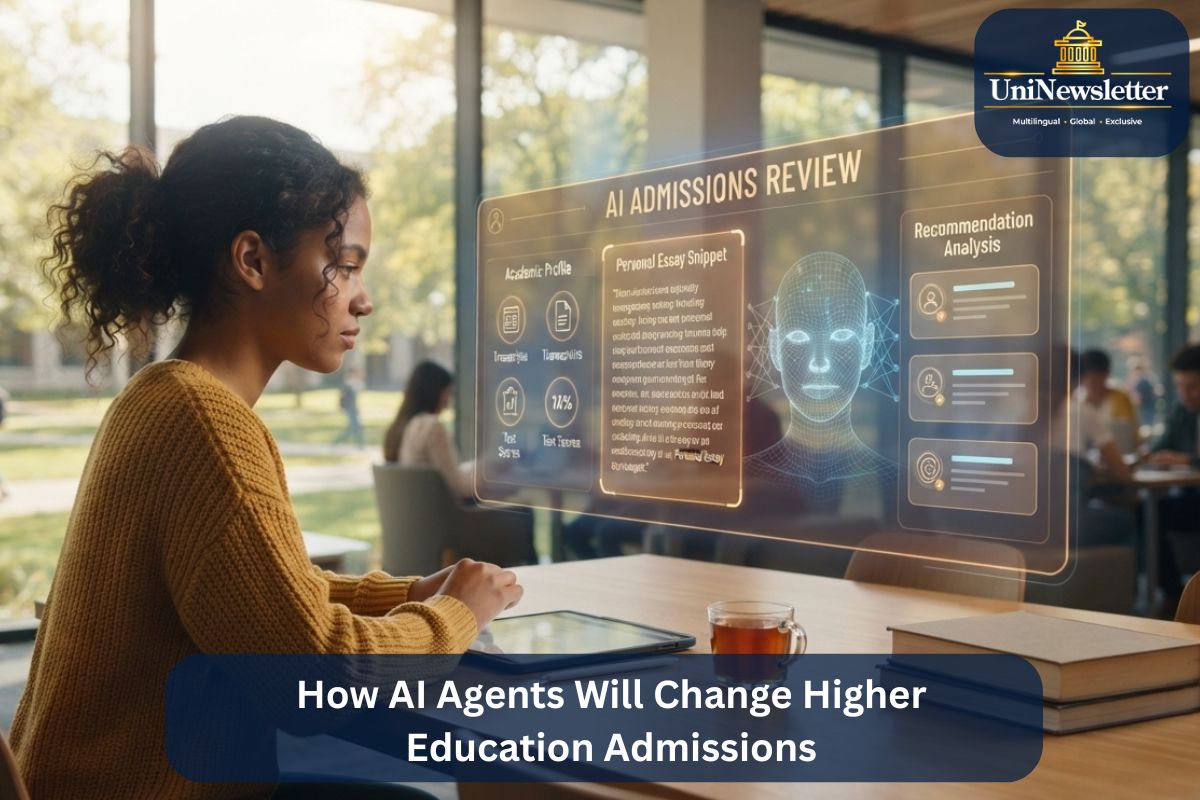
What Are AI Agents in Higher Education? An AI agent is meaningfully different from the chatbots universities have used for years. A chatbot just answers questions and stops there. An AI agent however is able to take actions like accessing a student information system to see application status, writing a custom follow-up email, and updating CRM records. The decision for human escalation is another step that AI agents can handle, without anyone manually initiating each stage.
Gartner's research frames this as a progression: AI agents are moving from basic assistants embedded inside existing business applications toward task-specific agents capable of genuinely autonomous action, and Gartner's own 2026 predictions on agentic AI frame this year as the point that shift becomes visible in everyday operations, higher education included. This is what separates artificial intelligence in university admissions today from the FAQ-answering bots of a few years ago.
Why Universities Are Adopting AI in Admissions The demographic cliff explains a lot of this urgency on its own. With a shrinking pool of traditional-age applicants, recruitment has become genuinely more competitive, and universities can't simply hire their way out of the problem when entry-level admissions turnover sits at 71% annually. EDUCAUSE's ongoing research on higher education technology trends has flagged workforce strain as one of the key pressures pushing institutions toward automation faster than originally planned. AI powered admissions process adoption isn't really optional at this point for institutions trying to maintain response times with fewer, more overworked staff.
There's also a channel-fragmentation problem AI is uniquely suited to solve. Roughly 48% of graduate students and 38% of undergraduates report using website chat features during their application journey, and students routinely start a conversation on a website, continue it by text, then follow up over email, expecting the institution to remember the full thread regardless of channel. Juggling that manually across a large applicant pool simply isn't realistic anymore. Our earlier piece on how artificial intelligence is transforming higher education covers the broader shift this sits within.
How AI Agents Are Transforming University Admissions From a close observation of higher education admissions automation trends based on actual implementation data from different institutions that have deployed such systems:
Inquiry and FAQ resolution: This is by far the most common type of interaction and covers students mostly asking for details such as submission deadlines, necessary documents, and requirements. With chatbots, they do not have to wait for an email reply or have their question stuck in an inbox.Application status and follow-up: Instead of a student only noticing a missing paper once the deadline has already passed, there are automated nudges, like gentle reminders, that catch the gap in advance, and push things forward.Behavioural and predictive outreach: A human agent is notified when an interested student is contacting less frequently which can bring timely and personalised interaction without having to go to mass mailing the student.Cross-channel continuity: A chat, for instance, can be continued via text or email without requiring the student to explain the same thing multiple times.As a Druid AI global benchmark from 2026 focusing on institutions of higher learning, AI systems manage about 99.5 percent of the chat and voice interactions completely independently without needing any human help and besides, In reality 0.5% of the instances require human intervention does not mean that AI failed, because these are the situations that require human expertise and discretion anyway like handling cases involving sensitive issues of privacy and policy. Inside Higher Ed's ongoing coverage of AI adoption on campus has documented similar patterns across a broader range of institutions beyond any single vendor's customer base.
Benefits of AI in University Admissions The genuine upside goes beyond simply reducing email volume, and it's exactly why automation in college admissions has moved from a pilot curiosity to a genuine operational priority this year:
Faster response times for applicants, particularly outside office hours when a live team simply isn't available More consistent communication across a large volume of applicants, rather than quality depending on which staff member picks up a query Freed-up capacity for admissions staff to focus on complex cases, appeals, and genuinely high-touch conversations that need a human Better data continuity across departments, since a student's registrar, financial aid, and admissions interactions increasingly need to be read as one relationship, not five separate silos Real-World Use Cases of AI in Higher Education Student recruitment powered by AI is making its appearance in various forms on several campuses which have adopted these systems. Predictive scoring of the lead (prospective student) points out which ones are most likely to be enrolled, by their engagement pattern. Because of this, the recruitment teams can focus their outreach efforts without a loss of time that the same inquiries could have resulted in. Documents missing are automatically chased to get the missing parts like the transcripts or test scores, without a person manually going from one applicant's file to another one of the team.
There's virtually no interruption to the flow of conversations between a prospective student and the university even during the hours when neither party is physically present on campus due to the always-on virtual assistants. These hours could be decisive moments for the prospective student in their choice to apply elsewhere. Universities' AI adoption of admissions tools also has the advantage of making integration easier with their current CRM and student information system so that the university recommendations are always fresh, real-time data, and not a snap picture of a few weeks ago.
Will AI Replace Admissions Officers? Almost certainly not in the way that question implies, and the data actually backs this up. That 99.5% containment rate for routine queries doesn't mean 99.5% of the job is automatable, it means the repetitive, high-volume part of the job is. The genuinely important admissions work, evaluating a borderline application holistically, having a real conversation with an anxious first-generation student, making judgment calls on exceptions, still requires a human, and arguably requires more human attention now that routine questions aren't eating up an officer's entire day.
The better understanding of the matter is that it is not the elimination of jobs, but rather a transformation of jobs, the AI in student admissions changes student admissions officer's daily work. Less time spent creating the forty-first identical email of the week, more time talking with students and helping them to make the final decision on the university.
Challenges and Ethical Considerations Such changes do not come without real danger, and pretending that they do is a lie. Prejudice is the topmost issue, AI systems which are trained on historical admissions data should quietly reproduce the same bias that was present in the historical data thereby prejudicing precisely the kind of applicants that a university is aiming to reach through its widened outreach strategies. In addition, the issue of transparency is a significant one; students should be made aware if an AI agent is engaged in communication with them, rather than a human, and the higher education institutions are getting to a point where they will be expected to explicitly disclose such information instead of leaving the reader guessing.
Data privacy is another genuine concern, since these systems often pull from multiple university databases simultaneously, and a poorly governed integration creates real exposure. And there's a structural risk worth naming honestly: over-reliance on automation without adequate human oversight can quietly erode the personal touch that, for a lot of applicants, was the actual reason they chose one university over another in the first place.
The Future of AI in Higher Education Admissions The future of AI in higher education points toward considerably deeper personalisation, predictive analytics identifying which students need outreach before they've even asked a question, integration with voice assistants and messaging channels students already use daily, and increasingly sophisticated reasoning about when and how to engage each individual student rather than applying one generic funnel to everyone. Our analysis of how technology will redefine higher education in the next five years covers where this broader trajectory is heading beyond admissions specifically.
It is worth noting that the introduction of agentic AI into the market is not assured to work simply because it is trending now. Gartner has stated that more than 40 % of agentic AI initiatives will be terminated by 2027 due to unclear ROI or poor governance among other reasons rather than because AI technology is not working. This is confirmed by McKinsey's study into enterprise AI adoption which indicates that it is organisation readiness that is the obstacle and not the technology itself.
How Universities Can Prepare for AI Adoption The institutions that are having actual results tend to have something in common: they are starting with a small pilot project addressing only one pain point rather than aiming to revolutionise the whole admissions process from day one. They wait until they have concrete results before considering any further expansion, and in the meantime, they focus on setting up the necessary governance and procurement documentation from the very beginning rather than adding oversight measures after a system is already live. Deep integration with the existing student information systems and CRMs takes precedence over nice-looking features because having an AI agent work with outdated or incomplete data leads to more than it solves. For institutions actively building out recruitment strategies alongside AI adoption, our guides on building a successful international student recruitment plan and top strategies universities use to attract international students are worth reading alongside any AI rollout plan.
Conclusion AI technology in university enrollment isn't a replacement for the human relationships that admissions has always depended on, it's a way of protecting the capacity for those relationships to actually happen, by clearing out the repetitive work that's been burning out admissions staff for years. The institutions getting this right are treating AI adoption as a governance and pilot-first exercise, not a wholesale replacement of their team. As universities continue to refine their use of AI, students and institutions alike need to stay informed about these ongoing changes. At UniNewsletter , we closely follow emerging trends in higher education, admissions, and international student services to provide timely insights that help students and universities navigate this rapidly evolving landscape with confidence. This is a real-time transformation, not a settled trend, making it more important than ever to keep up with the latest developments.
Frequently Asked Questions What are AI agents in admissions?
AI agents are computer programs that are able to decide on independent action, i. e. besides just checking application status, drafting follow-ups, updating records, and escalating cases of complexity, they also do things that a chatbot is not able to.
Will AI replace admissions officers?
Besides, no. AI works well for handling a lot of simple, identical queries but for the most complex situations, exceptions that are not common and authentic relationship development with prospects, only human judgment would do.
How can AI improve student recruitment?
Using lead scoring powered by machine learning, continuous engagement regardless of time of day, and outreach that is both timed and tailored to individual needs, based on the way a prospective student is actually interacting rather than following a template schedule for mass communication.
Are AI admissions systems fair?
Only then when the institution is actively managing it. There is a possibility that a system which is trained on the data of the past could carry over the same biases. That means, the institution has to keep checking whether it's fair to continue using such an automated system.
What are the risks of AI in higher education?
Risk of bias in machine learning, privacy leakage via data in integrated systems, failure to be transparent about the extent of AI's involvement in decision-making, and lack of human interaction with applicants.
How will AI shape future enrollment strategies?
From more tailored individual attention to anticipatory engagement that identifies the student needs even before the student asks, then seamless merging of all touch points the student might want to use, rather than driving everyone to participate in the same mass-produced process.

 26-05-2023
American University of Ras Al Khaimah
26-05-2023
American University of Ras Al Khaimah


 Featured Video