
Published on Jun 2026
Share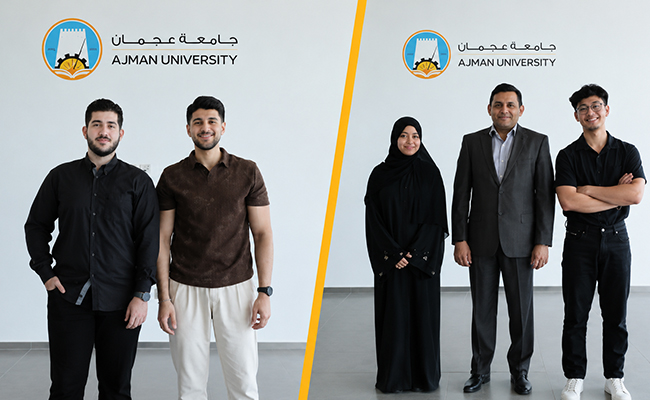
College of Engineering and Information Technology, Department of Biomedical Engineering, Ajman University, United Arab Emirates (UAE)
Delayed diagnosis is one of healthcare's most stubborn challenges. Heart disease and diabetic neuropathy both progress silently-often for years-before patients seek help. By that point, the clinical options have narrowed significantly. These diseases represent two of healthcare's most persistent detection problems.
Ajman University's (AU) biomedical engineering students, however, didn't wait for the industry to solve these dangers. Instead, they built the solutions themselves.
At AU's 2026 Business Innovation Exhibition, two undergraduate teams from the Department of Biomedical Engineering presented working prototypes designed to close the detection gap.
Pulse: The AI-Powered Mobile App that Assesses Heart Attack Risk Before Symptoms Emerge.
Students Nasima Mohammad Helal and Jon Zaccary Regala developed Pulse under the supervision of Dr. Mujeeb Rahman, Senior Lecturer in the College of Engineering and Information Technology. The application generates personalized cardiac risk assessments using accessible inputs-age, blood pressure and key health markers-putting preventive intelligence in patients' hands before a crisis develops.
Astoundingly, the prototype achieved 98.3% accuracy during testing. Pulse was built with equity in mind as much as precision, designed to extend preventive care into communities underserved by specialist services.
The team is actively seeking partnerships with healthcare institutions and government bodies to refine the model with regionally relevant data.
DiaSens: The Medical Device Detecting Diabetic Neuropathy Early-Before It Leads to Ulcers, Infections or Amputations.
Conventional neuropathy screening has a reliability problem. Results depend heavily on patient self-reporting and inconsistent testing conditions, making early diagnosis difficult precisely when it matters most.
Students Mohammed Wattar and Ali Hasan built DiaSens to fix this issue. The device controls the exact frequency, vibration and pressure applied during assessment, thereby identifying the precise threshold at which sensation is lost. It transforms an inherently subjective process into a repeatable, quantifiable clinical measurement.
Lab testing is complete. Clinical trials are the next phase.
What This Signals for Higher Education.
Both projects came out of student workspaces and not corporate R&D, which is a meaningful distinction.
It reflects what research-active universities are increasingly demonstrating: that undergraduate education, when oriented toward real-world problems, produces outcomes with genuine societal value-not merely academic ones.
At AU, that outward-facing philosophy is embedded in how biomedical engineering students are trained; in other words, not only to master technical skills, but to identify where those skills can create measurable impact. Pulse and DiaSens are evidence of what that approach looks like in practice.
For the broader higher education sector, the message is clear. The most compelling case for university relevance isn't made in mission statements, but rather on exhibition floors, in student workspaces, by undergraduates solving problems the industry hasn't cracked yet.