
Published on Aug 2025
Share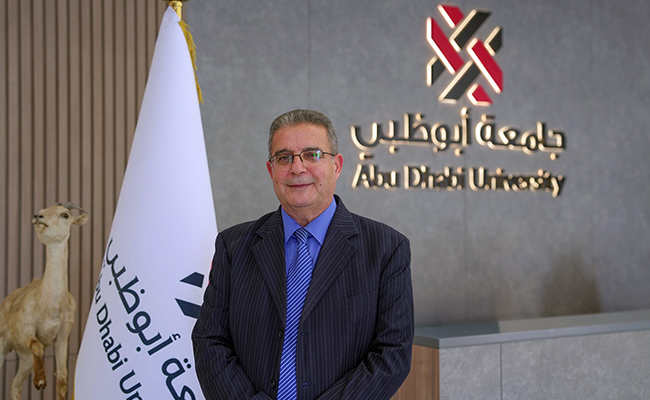
As Chancellor of Abu Dhabi University (ADU), I have spent much of my career reflecting on the evolving role of higher education—not just as a pathway to individual success, but as a force for societal transformation. In the Gulf Cooperation Council (GCC) region, where national visions are bold and change is happening at breathtaking speed, universities are uniquely positioned to lead that transformation. We are no longer content to follow best practices; we are now helping to shape them.
Across the GCC, governments are increasingly positioning education as a cornerstone of their economic diversification strategies. From Saudi Arabia’s Vision 2030 to Qatar’s NationalVision 2030, the region is aligning higher education with innovation, human capital development and global competitiveness. In this shared context, universities are moving beyond traditional models—embracing digital transformation, private-sector partnerships and new forms of credentialing.
Over the past decade, I have had the honor of watching—and
participating in—an extraordinary evolution in how we think about higher
education in the region. From the increasing influence of artificial
intelligence and digital learning to the aspirations of Gen Z students,
who are as globally connected as they are locally grounded, the terrain
has changed. And it will continue to do so.
Aligning Ambition with Strategy: A Regional Imperative
The transformation of higher education in the GCC is not happening in isolation. It is part of a much wider realignment, as our nations move boldly toward post-oil, knowledge-based economies. In the UAE, initiatives such as UAE Centennial 2071 articulate a long-term vision for national development, one that places human capital, innovation and education at the very center.
But this vision is echoed across our region. New science parks in Saudi Arabia and Qatar, branch campuses of leading universities in the UAE and a growing focus on entrepreneurial ecosystems are hallmarks of this shared shift. Institutions from Kuwait to Bahrain are investing in digital infrastructure, upskilling programs and applied research—all aimed at producing graduates equipped for a fast-changing, globalized world.
At ADU, our strategic priorities are deeply aligned with these national and regional objectives. We are proud to be one of the UAE’s leading institutions, not only in terms of rankings and research output, but in our contribution to the broader societal good. We view ourselves not only as a university, but as a partner in the nation’s—and the region’s—future.
Rising Recognition: Not Just Rankings, But Relevance
Recent years have seen ADU receive growing international recognition. In the 2025 Times Higher Education World University Rankings, we were placed 191st globally, with our Business & Economics programs ranked 62nd in the world. We’ve achieved strong placements in the QS rankings, including a top 200 global ranking for our MBA, and we made our debut in the Shanghai Ranking’s Global Ranking of Academic Subjects for Law and Management.
These milestones reflect a broader rise in Gulf institutions on the world stage. Saudi Arabia’s King Abdulaziz University, Qatar University, and Kuwait University have also climbed steadily in international rankings. In the THE Arab Region Rankings, Gulf universities consistently dominate the top 20. These successes illustrate a wider regional ambition—not simply to modernize education, but to lead globally in selected areas of academic excellence.
When we received the
Leadership and Management Team of the Year award at the THE
Awards Arab World 2024, it was not merely a proud moment for our team.
More so, it was a reflection of the hard work of our faculty, staff and
students—and a validation of the success of our institutional culture of
innovation and accountability.
Preparing Students for the Real World—and the Unknown
We are currently in the midst of an exceptionally profound shift in what it means to be “prepared” for the workforce. Employers today seek far more than technical qualifications; rather, they want graduates who are emotionally intelligent, ethically grounded and equipped to work in diverse, multidisciplinary teams. At ADU, we’ve embraced this reality wholeheartedly.
This focus on graduate employability and “future-readiness” is shared across the GCC. In Saudi Arabia and the UAE, national accreditation bodies now assess university performance based on graduate outcomes, industry partnerships and real-world skills development. The UAE’s Commission for Academic Accreditation (CAA), for instance, uses a six-pillar framework that includes employability, industry collaboration and research impact.
I often tell our students that intelligence today is plural, not singular. It’s not just about IQ anymore. It’s about digital intelligence, cultural fluency, emotional awareness as well as ethical judgment. Our graduate attributes framework builds on this idea, helping students develop the breadth of competencies they’ll need to succeed—not only in their first job, but across the arc of their lives.
We’ve invested significantly in project-based learning, experiential education and industry partnerships to ensure our students engage with real-world problems. Our Industry Engagement Program connects students with more than 2,000 partners, while our Global Engagement Program links us to over 5,000 academic collaborators worldwide. These are not just numbers—they are pathways to new ideas, cultural exchange and meaningful career opportunities.
A report by the McKinsey Global Institute predicts that by 2030, automation could lead to the loss of up to 800 million jobs worldwide, but 950 million new jobs will be created. Therefore, it is crucial for graduates of universities to develop exceptional skills beyond their areas of specialization by embracing the various qualities mentioned earlier.
Technology as Enabler, Not Replacement
The digital transformation of higher education is no longer on the horizon—it is already here. But at ADU, we’ve been intentional in ensuring that technology enhances, rather than replaces, the human elements of learning.
This is a shared priority across the GCC. Many universities are investing in smart campus technologies, AI-driven learning platforms and predictive analytics to improve student engagement and success. In Qatar and Saudi Arabia, universities have launched national AI and digital literacy initiatives to equip both faculty and students with next-generation skills.
We’ve developed our own smart campus infrastructure that incorporates
predictive analytics, personalized learning journeys and AI-supported
academic support. We’ve also upgraded our Learning Management System to
offer flexible, interactive digital content that aligns with students’
needs and learning styles.
Entrepreneurship, Innovation and the Future of Work
In line with the UAE’s drive for economic diversification, ADU is placing entrepreneurship and innovation at the heart of our strategy. Through our Innovation Center, we support students in developing and launching their own ventures. We want our graduates to see themselves not only as job seekers, but as job creators.
This approach reflects a regional trend. GCC nations are building national entrepreneurship ecosystems, with incubators, startup competitions and SME support networks now integrated into the educational landscape. From Bahrain’s Tamkeen programs to Saudi Arabia’s MiSK Foundation, higher education institutions are being called to play an active role in job creation.
We are actively designing programs that respond to emerging fields, from AI ethics to green technology. These are areas that not only matter for employment but for society at large. Our research institutes are similarly focused on national and regional priorities, with thematic areas in health, sustainability, education and digital innovation.
A Global University with a Strong Local Soul
One of our guiding principles at ADU is to remain globally minded and locally rooted. Internationalization is not just a matter of branch campuses or exchange programs. It’s about creating a campus culture where diverse perspectives are valued, global challenges are understood and local realities are respected.
We are proud to partner with universities around the world, but we are equally proud of the ways in which we embed Arabic and Islamic values into our curriculum and campus life. This emphasis on cultural identity and relevance is echoed by our peers across the GCC, who are also working to integrate heritage and global outlook in their academic environments.
Looking Ahead: Shaping, Not Just Surviving, the Future
As I reflect on the future of higher education in our region, I am both realistic and deeply optimistic. We face complex challenges, from climate change to automation, but I believe that universities like ours—grounded in mission and bold in strategy—will continue to play a pivotal role.
At ADU, we are not just responding to change. We are helping to shape it. Through our partnerships, pedagogy, research and student engagement, we aim to contribute to a higher education ecosystem that is inclusive, future-focused and socially impactful.
And while ADU’s journey continues, it is part of a broader story—a
regional movement of Gulf universities working together to redefine what
higher education can and should be. My message to fellow educators and
institutional leaders is simple: this is our moment. Let’s use it not
just to adapt—but to imagine, build and lead.